Author: minimolar

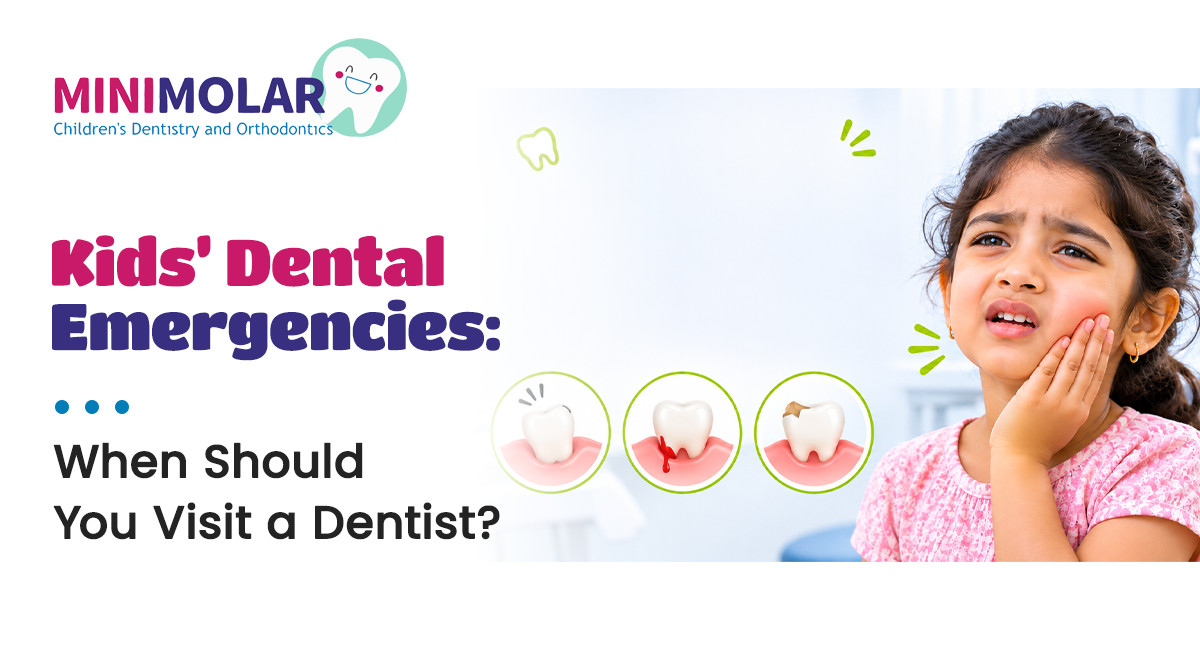
  • Kids’ Dental Emergencies: When Should You Visit a Dentist?

    Kids’ Dental Emergencies: When Should You Visit a Dentist?

    It’s 9 PM, and your child is crying with a toothache, or a tooth just came out after a fall. You’re asking yourself two questions at once. Is this an emergency, and who do I call right now?

    Here’s the short answer. When should your child visit a pediatric dentist? Go the same day for a knocked-out permanent tooth, severe toothache, pain that wakes your child at night, a swollen face or gum, or a broken tooth. Otherwise, book a routine visit every six months.

    Our dentists at Mini Molar Kids Dental Clinic in Rajarajeshwari Nagar see only children, and we keep same-day slots for urgent problems. Read on to sort true emergencies from worries that can wait, learn what to do in the first few minutes, and know exactly where to go.

    When Should Your Child Visit a Pediatric Dentist?

    See a pediatric dentist the same day for urgent problems, within a few days for smaller concerns, and every six months for routine care. The American Academy of Pediatric Dentistry advises a first visit when the first tooth appears, and no later than one year of age.

    The table below sorts the common situations.

    Situation When to Go
    Knocked-out permanent tooth Immediately
    Severe toothache, or pain that wakes your child at night Same day
    Swollen gum or face, with or without fever Same day
    Broken or chipped tooth Same day
    Loose tooth after a fall Within 24 hours
    White or brown spots, food stuck between teeth Within a few days
    No problem, just a check-up Every six months

    Children at higher risk of cavities may need visits every three to four months. Our dentists decide this after a caries risk assessment, which is a review of your child’s diet, saliva, and dental history.

    What Counts as a Dental Emergency in a Child?

    A dental emergency is any tooth or mouth problem that causes severe pain, heavy bleeding, swelling, or damage to a permanent tooth. These need a dentist the same day, because delay lowers the chance of saving a knocked-out tooth and lets an infection spread.

    These are the situations we treat as urgent:

    • A permanent tooth knocked out or pushed out of place
    • Toothache that doesn’t ease with a cold compress
    • Pain that wakes your child at night
    • Swelling of the gum, cheek, or face
    • A broken front tooth
    • A tooth that turns grey after a fall

    A baby tooth knocked out before its time also needs a check. Baby teeth hold space for the adult teeth underneath, so an early loss can shift the neighbouring teeth.

    What Should You Do Right Away After a Tooth Injury?

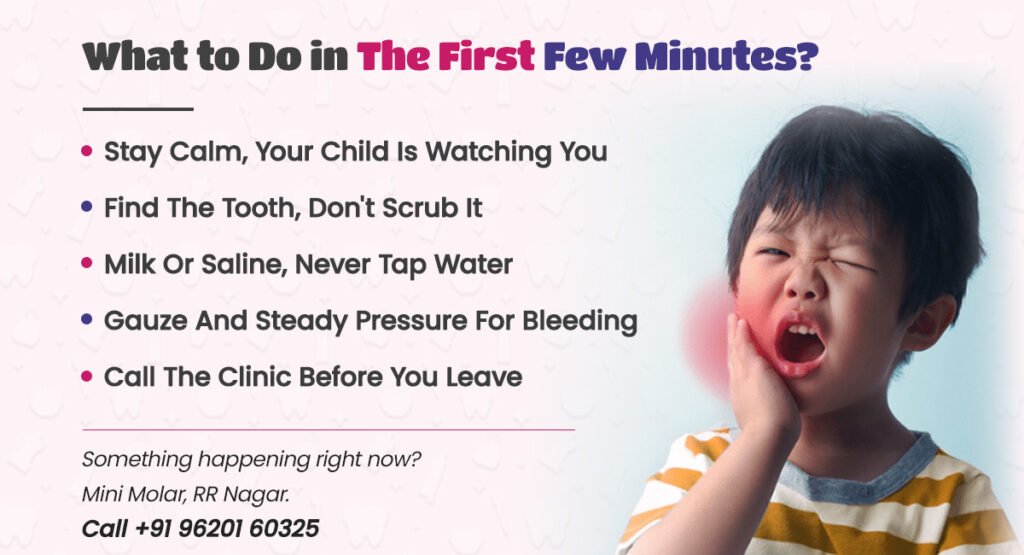
    Stay calm, stop the bleeding, and call the dentist. The first 30 minutes matter most if a permanent tooth is knocked out. According to University of Michigan Health, putting the tooth back within 30 minutes gives the best result, and success is unlikely after 2 hours.

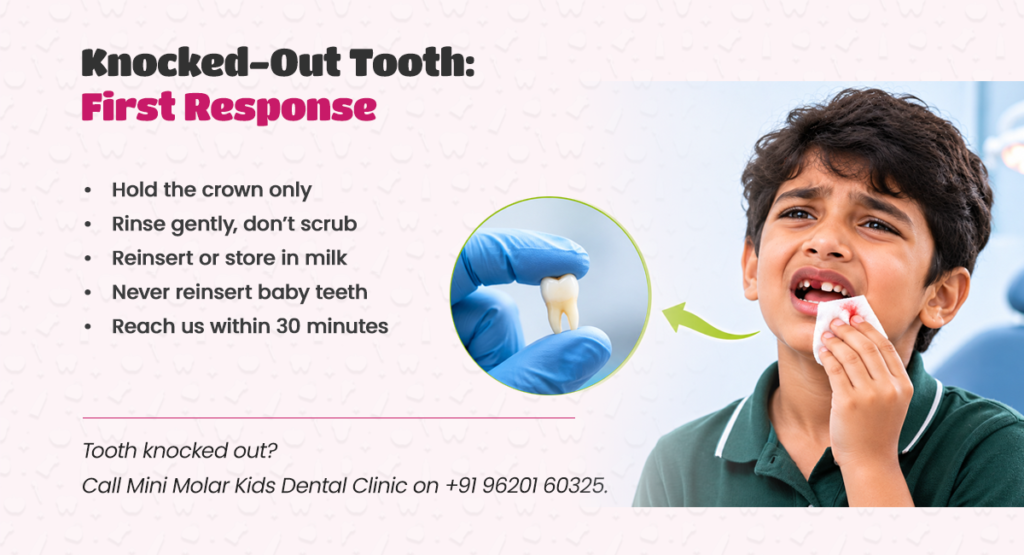
    For a knocked-out permanent tooth, follow these steps:

    1. Press clean gauze on the gum to control bleeding.
    2. Pick up the tooth by the crown, the white chewing part. Don’t touch the root.
    3. Rinse it gently with tap water. Don’t scrub it.
    4. If your child is old enough to stay still, gently place the tooth back in the socket and have them bite on gauze. Otherwise, store it in milk (Cold Pasteurized Milk ). Don’t use salt water, alcohol, or mouthwash.
    5. Call us straight away and bring the tooth.

    For a knocked-out baby tooth, press gauze on the gum for about 15 minutes. Never push a baby tooth back in. Your child still needs a dental check, even if the tooth was close to falling out anyway.

    For a broken tooth, rinse the mouth, keep the broken toothpieces, and apply a cold compress outside the cheek.
    pediatric dental clinic bangalore

    When Does a Toothache or Swelling Mean Infection?

    A toothache with a swollen gum, face, or jaw, or with fever, suggests an infection that needs a dentist the same day. A dental abscess is a pocket of pus that forms around an infected tooth, usually after a deep cavity or an injury.

    Kaiser Permanente’s care guidance lists red, swollen gums, throbbing pain when chewing, a bad taste in the mouth, and fever as signs. It also says to seek care right away if pain, swelling, warmth, or redness increases, if red streaks spread from the area, or if pus drains out.

    Antibiotics can calm an infection for a while. They don’t remove its source, though. That’s why our dentists treat the tooth itself.

    Should You Go to a Hospital or a Pediatric Dentist?

    Go to a hospital emergency department for trouble breathing or swallowing, a head injury, bleeding from nose, loss of consiousness,, or swelling that spreads fast across the face or neck. Go to a pediatric dentist for teeth, gum, and bite problems.

    Many emergencies need both. A fall can bump the head and break a tooth. Check your child’s alertness and breathing first. Then call us about the tooth, and we’ll guide you.

    If your child cut the lip or tongue, our guide to lip and tongue injuries explains when stitches might be needed.

    Will an Emergency Visit Frighten My Child?

    Our dentists keep emergency visits short and gentle. We explain each step in simple words, show the tools, and then act. You can stay in the room, and toddlers can sit on your lap for the exam if they’d like.

    We treat the most painful problem first. We take an X-ray only when it’s needed to see the root or a fracture.

    You can help before you arrive. Keep your own voice steady, and tell your child the dentist will make the tooth feel better. Avoid promises like “it won’t hurt at all”, because you can’t be sure of that.

    What Treatment Might Your Child Need After a Dental Emergency?

    Treatment depends on which tooth is hurt and how deeply. Our dentists examine the tooth, the gum, and the bite, and then explain the options before starting.

    Depending on the injury, your child may need:

    • A tooth coloured filling or a stainless steel crown to rebuild a broken tooth
    • A pulpotomy, which is partial nerve treatment
    • A pulpectomy, which is root canal treatment for a baby tooth
    • Teeth repositioning with splints if teeth are shaking within the socket
    • Tooth fragments reattachment depending upon the injury & availability of tooth pieces A space maintainer, a small appliance that holds the gap when a baby tooth is lost early

    Some teeth need only monitoring. After a knock to a tooth, we review it again at later visits, because nerve damage can show up weeks afterwards.

    Book Your Appointment With the Best Pediatric Dentist in Bangalore for Emergencies

    Parents searching for the best pediatric dentist Bangalore offers should look for a clinic that treats only children and keeps slots open for urgent problems. That’s how Mini Molar Kids Dental Clinic works.

    • Children only, from the first tooth to the last permanent molar
    • Same-day slots for toothache, swelling, and injuries
    • Phone guidance on whether to come in or go to a hospital
    • Check-ups every three to four months for higher-risk children

    We’re a pediatric dental clinic Bangalore families can reach quickly, so call early. Dial +91 96201 60325, tell us what happened and when, and we’ll guide your next step.

    Need an emergency dentist for child in RR Nagar? Visit us at No 1132, 1st Floor, Jawaharlal Nehru Road, BEML Layout 3rd Stage, RR Nagar, Bengaluru 560098. Bring any tooth pieces in milk.

    Source basis: American Academy of Pediatric Dentistry guidance on the first dental visit, University of Michigan Health first aid guidance for a knocked-out tooth, Kaiser Permanente care instructions for an abscessed tooth in children, and our own clinical practice.

    This content is for parent education only and isn’t a substitute for emergency medical care. If your child is struggling to breathe or isn’t acting normally, go to the nearest hospital emergency department now. A dentist must examine your child’s teeth, gums, and X-ray findings before confirming any diagnosis or treatment.

    Frequently Asked Questions

    Should I put a knocked-out tooth back in the socket?

    For a permanent tooth, yes, if your child is old enough to stay still. Place it gently, leave it slightly raised if needed, and have your child bite on gauze. Never reinsert a baby tooth.

    Is a loose baby tooth after a fall an emergency?

    Usually not, but it needs a check within 24 hours. The fall can damage the permanent tooth underneath. Don’t wait if there’s heavy bleeding, severe pain, or swelling.

    Can I give my child painkillers for a toothache?

    Ask your doctor or dentist which medicine and dose suit your child’s age and weight. Follow the label, and never give adult doses. A cold pack outside the cheek can also ease pain.

    What if my child’s tooth turns grey after a fall?

    Book a dental visit soon. A grey tooth can mean the nerve inside was hurt. Our dentists check it with an examination and, if needed, an X-ray.

    Does my child need an X-ray after a tooth injury?

    Not always. A dentist takes an X-ray when a tooth looks loose, chipped, or out of place, or when a root fracture is possible. We use X-rays only when they’re needed.

    Do I need an appointment for a dental emergency?

    Call first, even if you’re already on your way. We’ll ask what happened, tell you whether to come to Mini Molar Kids Dental Clinic or go to a hospital, and prepare for your arrival.
  • Lip or Tongue Injuries Caused by Teeth: When Should You Seek Emergency Dental Care?

    Lip or Tongue Injuries Caused by Teeth: When Should You Seek Emergency Dental Care?

    Your child just fell, or bitten down hard, and blood coming from their lip or tongue. Your heart races, and you wonder whether to rush to a hospital, call a dentist, or press a cold cloth and wait.

    Here’s the short answer. Seek emergency care when bleeding doesn’t stop after 15 minutes of firm pressure, when the cut is deeper than 2 cm or gaping, or when your child struggles to breathe or swallow. A chipped or knocked-out tooth also needs a dentist the same day.

    Our dentists at Mini Molar Kids Dental Clinic in Rajarajeshwari Nagar treat only children, and we handle mouth injuries from falls, sports, and accidental bites. Read on for first aid steps, warning signs that can’t wait, to know more about when should you seek emergency dental care and how to choose where to go.

    When Should You Seek Emergency Dental Care?

    Seek emergency dental care when a child has heavy bleeding that won’t stop, a gaping or deep cut, a loose, chipped, or knocked-out tooth, or swelling that keeps growing. Go to a hospital emergency department straight away if your child has trouble breathing, swallowing, or opening and closing the mouth.

    According to the American Academy of Pediatrics (HealthyChildren.org), call emergency services if your child isn’t waking up or acting normally, has severe neck pain, or is bleeding heavily. A head injury always comes first. Teeth can wait a few minutes. A brain injury can’t.

    How Do Teeth Injure a Child’s Lip or Tongue?

    Teeth can injure the lips and tongue in two main ways: a blow that forces the soft tissues against the sharp tooth edges, or an accidental bite on the tissue itself. The result is a laceration, which is simply a cut or tear in the skin or lining of the mouth.

    These situations bring most parents to us:

    • A fall off a bicycle or scooter, where the upper teeth cut into the lower lip
    • A collision at school or during sports
    • A chipped tooth with a sharp edge that keeps scratching the cheek or tongue
    • Biting a numb lip or tongue after dental treatment, because the child can’t feel the pain
    • A tooth pushed into the lip during a fall

    The mouth bleeds a lot because it has a rich blood supply. A small cut can look dramatic. That’s normal, and it also heals quickly. Still, you can’t judge the damage from the blood alone.

    What Should You Do in the First 15 Minutes?

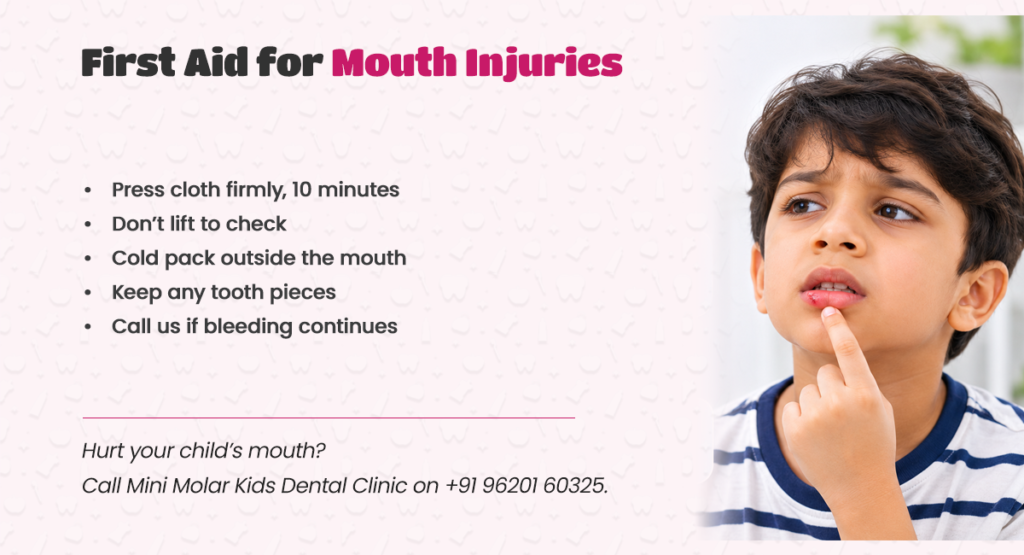
    Press firmly on the wound with clean gauze or cloth and keep pressing for 10 minutes without peeking. The American Academy of Pediatrics gives this exact timing, and checking early restarts the bleeding.

    Follow these steps in order:

    1. Wash your hands, or wear gloves if you have them.
    2. Press clean gauze or a cloth firmly on the cut. For a lip, squeeze the outer lip against the teeth.
    3. Hold for 10 minutes. Don’t lift the cloth to check.
    4. Rinse an inside-mouth cut with cool water. Wash an outer lip cut gently with soap and water, without scrubbing.
    5. Hold a cold pack wrapped in a towel on the outside of the mouth to ease swelling.
    6. Look for a chipped tooth, a loose tooth, or a missing fragment.

    Keep any broken tooth piece. If a permanent tooth is knocked out, hold it by the crown, rinse it gently, store it in milk or saline, and reach us as quickly as you can. Never push a baby tooth back into the socket.

    emergency dentist for child in RR Nagar

    Does a Lip or Tongue Cut Need Stitches?

    A cut needs stitches, which doctors also call sutures, when it’s bigger than 2 cm, looks deep, or keeps bleeding after 15 minutes of steady pressure. Cuts that go through the edge of the lip or across the edge of the tongue also need a medical check.

    Gaping edges don’t close well alone. A lip edge that heals out of line is hard to fix later, so don’t wait to see how it looks tomorrow. Small cuts inside the mouth often heal without stitches, but a doctor or dentist should still look at them.

    Tetanus matters too. Tetanus is a serious infection that enters through dirty wounds. Seattle Children’s advises seeking care if your child has never had a tetanus shot, or if the cut is dirty and your child’s last shot was more than five years ago. Check your child’s vaccination card.

    Should You Go to a Dentist or a Hospital?

    Go to a hospital emergency department for heavy bleeding, breathing or swallowing trouble, a head injury, or a deep cut that needs stitches. See a dentist the same day for broken, loose, or knocked-out teeth, or when a tooth edge keeps cutting the mouth.

    Many injuries need both. A fall can split the lip and chip a tooth in one moment. In that case, control the bleeding first, then call us. We’ll tell you whether your child can come in or should go to a hospital first.

    If you live nearby and need an emergency dentist for child in RR Nagar, we keep same-day slots for severe toothache, facial swelling, a broken front tooth, and pain that wakes a child at night. Call before you leave, so our team can get ready.

    Am I Overreacting If I Take My Child In Now?

    No. A short visit that ends with “this is fine” costs you less than a missed problem does. Parents worry about wasting a dentist’s time, and we understand that. We’d still rather see a child with a harmless cut than miss a tooth that needs urgent care.

    Some injuries give no loud signal. A tooth can look fine after a fall, yet the nerve inside may be damaged. A tooth that slowly turns grey after an injury is one example. Swelling that grows after two days is another.

    Trust your instincts. If your child won’t eat, won’t play, or keeps touching the same spot, call us.

    How Do Lip and Tongue Injuries Heal at Home?

    Small mouth cuts usually heal in 3 to 4 days, according to Seattle Children’s. A white patch over the wound is normal healing, not infection.

    Here’s how to help:

    • Give soft, cool foods such as curd, milkshakes, and ice lollies
    • Skip spicy, salty, and citrus foods until the cut closes
    • Rinse the mouth with warm water after meals
    • Use paracetamol or ibuprofen for pain, in the dose advised by your doctor for your child’s weight
    • Apply a cold cloth to the outside of the lip for swelling

    Call the doctor or dentist if pain stays severe after medicine, or if swelling and pain grow after 48 hours. Redness, pus, or fever mean the wound may be infected. A small amount of oozing for a few hours is normal.

    What Will Our Dentists Check During a Visit?

    Our dentists check the wound, every tooth, the bite, and the gums, and they take an X-ray only when it’s needed. We look for chips, loose teeth, fragments left in the lip, and signs that the nerve inside a tooth has been hurt.

    We also take time to calm your child. Our team explains each step in simple words, and you can stay with your child throughout. When a hospital is the right next stop, we say so plainly. If teeth need treatment, we tell you the options and the follow up checks.

    That’s the idea behind paediatric dental care in RR Nagar at our clinic: one dental history that follows your child from the first tooth to the last permanent molar. After an injury, we review the tooth again at later visits, because nerve problems can appear weeks afterwards.

    How Can You Book an Emergency Visit at Mini Molar Kids Dental Clinic?

    Call +91 96201 60325 and tell us what happened, when it happened, and whether the bleeding has stopped. We’ll guide you on first aid over the phone and tell you whether to come in or head to a hospital.

    You’ll find us at No 1132, 1st Floor, Jawaharlal Nehru Road, BEML Layout 3rd Stage, RR Nagar, Bengaluru 560098. Bring your child’s vaccination record if you have it, along with any tooth pieces in milk.

    This content is for parent education only and isn’t a substitute for emergency medical care. If your child is bleeding heavily, struggling to breathe or swallow, or isn’t acting normally, go to the nearest hospital emergency department now. A dentist must examine your child’s mouth before confirming any diagnosis or treatment.

    Frequently Asked Questions

    How long should a child’s tongue bleed after a bite?

    Bleeding should slow within 10 to 15 minutes of firm pressure. Some light oozing for a few hours is normal. If heavy bleeding continues after 15 minutes of steady pressure, go to an emergency department.

    Can a child’s cut lip heal without stitches?

    Small, shallow cuts inside the mouth often heal without stitches. A cut bigger than 2 cm, a deep cut, or one through the lip border needs a medical check. Don’t wait to see how it looks.

    What if my child bit their lip after dental treatment?

    Numbness after treatment can last a few hours, so children sometimes chew the lip without feeling it. Offer soft food, watch your child closely, and call us if swelling or a sore appears.

    Should I put ice on a bitten tongue or lip?

    Yes. Wrap ice or a cold pack in a towel and hold it on the outside of the lip or cheek. A popsicle or small ice chip to suck on can ease swelling if your child’s age allows it.

    When does a child’s mouth injury need an X-ray?

    A dentist takes an X-ray when a tooth looks loose, chipped, or pushed out of place, or when a fragment may remain in the lip. Low dose X-rays are used only when needed.

  • Tooth-Friendly Snacks That Help Keep Your Child’s Teeth Healthy

    Tooth-Friendly Snacks That Help Keep Your Child’s Teeth Healthy

    It’s 4 pm, your child is hungry, and dinner is hours away. Most parents reach for whatever’s closest, and our dentists understand why. But that snack decides how hard your child’s teeth work against sugar for the next half hour.

    Smart snacks for healthy teeth are low in added sugar, easy to rinse off, and served at set times. Fresh fruit, plain yogurt, cheese, and roti with vegetables all fit. Sticky sweets, biscuits, and slowly sipped juice don’t. At Mini Molar Kids Dental Clinic in Rajarajeshwari Nagar, our dentists ask about snacks at every cavity check, because what your child eats and how often matters as much as brushing. Here’s what we tell parents in the chair.

    How Does Snacking Affect a Child’s Teeth?

    Every snack feeds the bacteria in plaque, and those bacteria turn sugar into acid that attacks enamel for about 20 minutes. Plaque is the sticky film of bacteria on teeth. Enamel is the hard outer layer that protects each tooth.

    Early on, the acid pulls minerals out of the enamel. We call this demineralisation. Saliva, fluoride, and a gap between snacks let the enamel remineralise, which means the minerals return.

    Each new snack restarts that 20-minute clock. If your child grazes from 4 pm until bedtime, the teeth stay under attack for hours, even on small portions. The American Dental Association says limiting snacking helps prevent tooth decay. Children’s enamel is thinner than yours, so decay moves faster once it starts.

    What Are the Best Smart Snacks for Healthy Teeth?

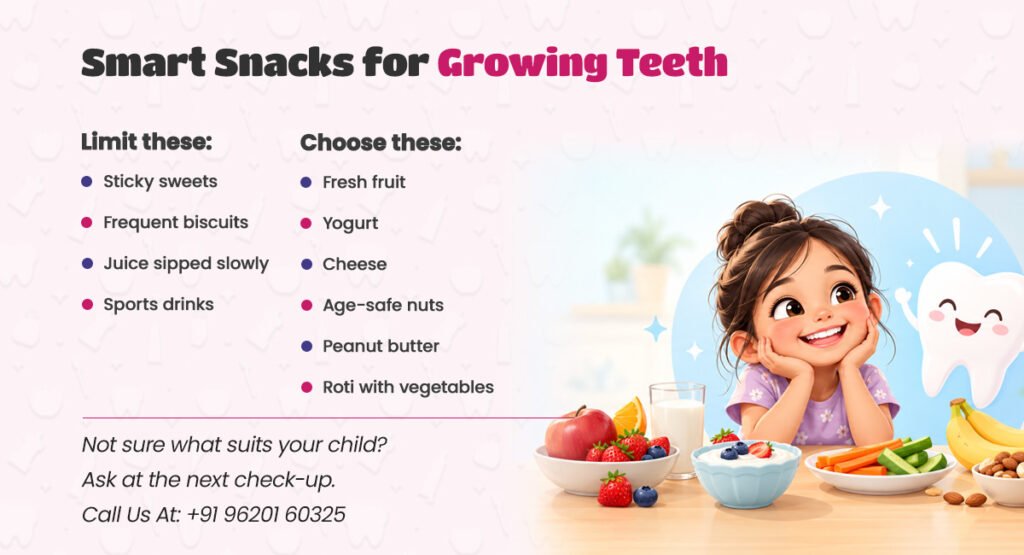
    Cheese, plain yogurt, fresh fruit, crunchy vegetables, roti with vegetables, age-safe nuts, unsweetened peanut butter, and water suit teeth best. They carry little added sugar, and most of them make your child chew, which keeps saliva flowing.

    Plain is the key word. Flavoured yogurt cups and sweetened spreads put the sugar back in. Whole fruit beats juice, because juice packs concentrated sugar into a drink your child can sip for an hour.

    Take care with nuts. Whole nuts can choke young children, and a nut allergy needs medical advice. Ask your dentist or paediatrician which nuts suit your child’s age.

    Which Snacks Raise the Risk of Cavities in Kids?

    Sticky sweets, biscuits, chips eaten often, packaged juice sipped slowly, and sports drinks raise cavity risk the most. All four keep sugar on the teeth for long stretches.

    Snacks with different consistency have different caries risk. Sticky foods cause the most trouble. Toffee, chikki, and dried fruit such as raisins cling to the grooves of the back teeth, and a toothbrush can’t always reach them. Jaggery and honey don’t solve the problem either. Teeth react to both much as they do to white sugar.

    We don’t ask parents to ban treats. Children push back when every treat disappears, so a swap works better. Offer a cheese cube where you’d usually offer a biscuit, or a whole apple where you’d pour juice.

    When Should Children Have Their Snacks?

    Give snacks at planned times and keep sweet treats for mealtimes, because every snack restarts a 20-minute acid attack. Three meals and two planned snacks give teeth long gaps to recover. Constant nibbling gives them no break, and that’s where most cavities start.

    These habits protect teeth day to day:

    • Set snack times, and skip grazing in between
    • Offer water between meals
    • Serve sweets with a meal, then offer water
    • Give nothing to eat or drink after the bedtime brush
    • Never let your child sleep with milk or a sweet drink in a bottle or sipper
    • Rinse the mouth with water after sports drinks or packaged juice

    Early childhood caries is tooth decay in babies and toddlers, often linked to night feeds and sweet drinks. If your toddler still feeds at night, cut those feeds down by 12 to 18 months to protect the front teeth.

    kids dentist near me

    What Does a Tooth-Friendly School Tiffin Look Like?

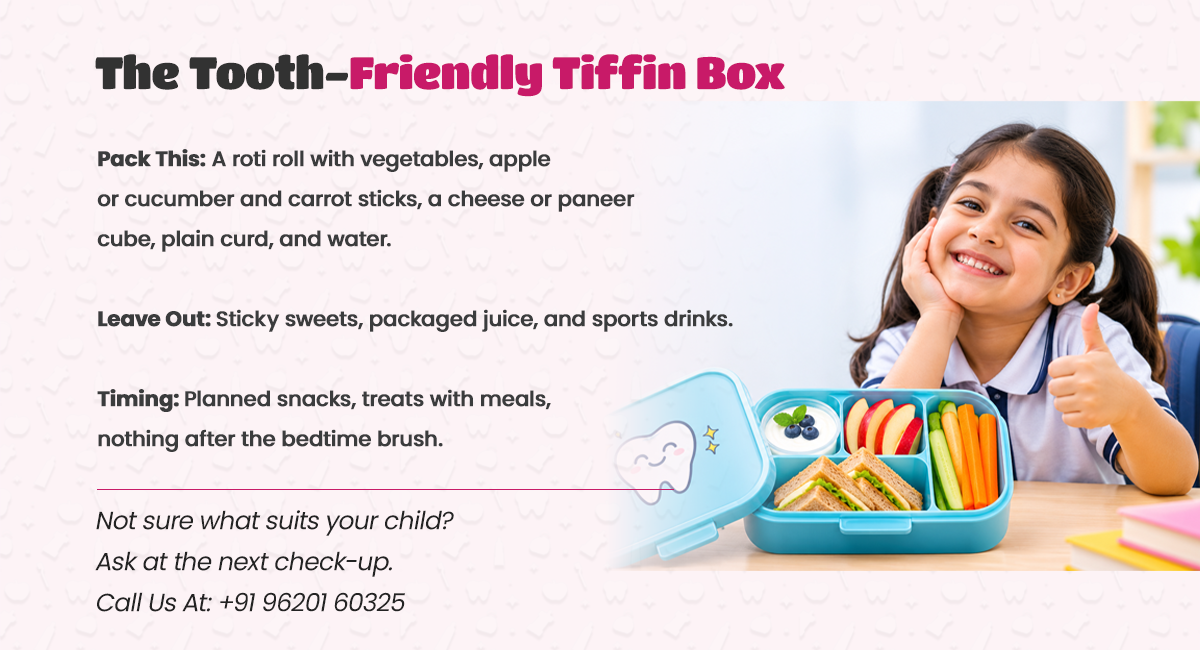
    A tooth-friendly tiffin has one filling item, one crunchy fruit or vegetable, a little dairy, and a bottle of water. You’ll pack it in five minutes.

    A few ideas that travel well:

    • A roti roll with vegetables
    • Apple slices, or cucumber and carrot sticks
    • Paneer cubes or a cheese cube
    • Plain curd in a small container
    • A water bottle

    Leave out sticky sweets and packaged juice. If your child gets a treat, pack it with the lunch so it arrives alongside a meal.

    Do Healthy Snacks Replace Brushing and Dental Check-Ups?

    No. Good snacks help, but your child still needs to brush twice a day with fluoride toothpaste and see a dentist regularly. Use a rice-grain smear of toothpaste up to age 3, and a pea-sized amount from age 3 to 6.

    At check-ups, our dentists do a caries risk assessment. That’s a review of your child’s diet, saliva, white spots, and dental history, and the result sets how often your child needs to come in. We often add fluoride varnish, a strengthening coating painted on the teeth, and sealants, thin coatings that block decay in the deep grooves of molars.

    Sealants go on first permanent molars at 6 to 7 years and on second molars at 11 to 13 years. Children at higher risk usually visit every 3 to 4 months.

    What Early Signs Show Snacks Are Affecting Your Child’s Teeth?

    Snacks can mark teeth long before your child says it hurts. Watch for these:

    • White or chalky spots near the gumline
    • Brown stains in the grooves of back teeth
    • Sensitivity to cold drinks or sweets
    • Bad breath or a sour taste
    • Chewing only on one side
    • Food getting stuck between teeth

    If you search for a child dentist near me after spotting these signs, book a check-up with our dentists at Mini Molar Kids Dental Clinic. If pain wakes your child at night, or the face swells, don’t wait. Call our clinic the same day.

    Book a Check-Up at Mini Molar Kids Dental Clinic

    Snack timing, snack choice, and daily brushing work together. Plan the snacks, pack water, and keep sweets for mealtimes. Then let a dentist check how it’s working, since your child’s risk isn’t the same as a friend’s.

    Mini Molar Kids Dental Clinic treats children only. Each visit starts with a clear explanation, and you can stay in the room if you’d like. Our team offers diet and sugar counselling, fluoride varnish, and sealants, and we keep same-day slots for severe toothache, swelling, or night pain.

    If you’re looking for a kids dentist near me, or a pediatric dentist near me in the RR Nagar area, call +91 96201 60325 to book. You’ll find us at No 1132, 1st Floor, Jawaharlal Nehru Road, BEML Layout 3rd Stage, RR Nagar, Bengaluru 560098. Bring a list of what your child usually snacks on, and our dentists will suggest changes you can keep up.

    This content is for parent education only. Every child’s risk differs, so a dentist must examine your child’s teeth, gums, and dental history before confirming any diagnosis or treatment. If your child has a medical condition, allergy, or feeding difficulty, don’t change the diet without asking your doctor first.

    Frequently Asked Questions

    Is fruit bad for my child’s teeth?

    No. Whole fruit brings fibre and makes your child chew, which keeps saliva flowing. Juice and dried fruit cause trouble, because juice goes down slowly in sips and dried fruit sticks to the back teeth.

    Are jaggery and honey better than sugar for teeth?

    No. Jaggery, honey, and brown sugar feed the same bacteria as white sugar, and teeth react to all of them in much the same way. Treat them as sweets, and serve them with meals so your child doesn’t nibble them all day.

    How many snacks a day are fine for a child?

    Fewer, planned snacks beat constant nibbling. Each snack restarts a 20-minute acid attack. Your child’s cavity risk level sets the right pattern, so ask your dentist at the next check-up.

    Is cheese good for children’s teeth?

    Yes. Plain cheese has little sugar and provides calcium, and chewing it keeps saliva flowing. Check for dairy allergy first, and pick plain cheese. Processed spreads aren’t the same thing.

    Can my child still have sweets or chocolates?

    Yes, in small amounts with a meal. But let that not be a habit on a daily basis. Try to reduce it to once a week or 2 . Offer water afterwards and keep up brushing twice a day. Sweets that linger, or get nibbled all afternoon, do more damage than one treat at lunch.

    Are nuts and peanut butter safe for kids?

    Take care with whole nuts. They can choke young children, so ask your dentist or paediatrician which form suits your child’s age. Peanut butter spread thinly is a common option, but check for allergies first.

  • When Do Baby Teeth Fall Out? A Parent’s Timeline Guide

    When Do Baby Teeth Fall Out? A Parent’s Timeline Guide

    Your child comes to breakfast with a wobbly front tooth. Or other parents are sharing tooth fairy photos while your child’s mouth hasn’t changed at all. Either way, you’re wondering whether the timing is normal.

    When do baby teeth fall out? Around age 6 for most children, starting with the lower front teeth. The last baby tooth goes around age 12, and a year either way is still normal. Mini Molar Kids Dental Clinic in Rajarajeshwari Nagar treats children only. The team keeps one dental record for each child, from the first tooth to the last permanent molar. Here’s the age chart, plus what to do at home and when to call.

    • When Do Baby Teeth Fall Out, and in What Order?

    Baby teeth fall out between ages 6 and 12, roughly in the order they arrived: front teeth first, back molars last. Baby teeth, also called milk teeth or primary teeth, are the first set of 20. Most children have all 20 by age 3.

    The American Dental Association (ADA) eruption chart gives these ages.

    Baby Tooth Typical Age It Falls Out
    Central incisors (front teeth) 6 to 7 years
    Lateral incisors (beside the front teeth) 7 to 8 years
    First molars 9 to 11 years
    Canines (pointed teeth) 9 to 12 years
    Second molars (last baby teeth) 10 to 12 years

    Treat the ages as averages. Teeth that came in late often leave late. Family patterns repeat too, so ask a grandparent when they lost their first tooth. A year off the chart isn’t a red flag.

    • What Happens Inside the Gum When a Baby Tooth Loosens?

    A permanent tooth grows underneath and slowly dissolves the root of the baby tooth above it. Dentists call this resorption. Once the root has gone, the baby tooth wobbles and drops out.

    The adult set has 32 teeth, including four wisdom teeth that arrive between ages 17 and 21. Most children have 28 by about age 13.

    Then there are the six-year molars. Four extra permanent molars arrive around age 6 to 7, behind the last baby molars. Nothing falls out to make room for them, so parents often mistake them for baby teeth. They aren’t. They have to last a lifetime, so protection starts early.

    • Why Do the New Teeth Look Bigger and Yellower?

    New permanent teeth look bigger and yellower than baby teeth. They are larger, and their enamel is more see-through, so the yellower layer underneath (dentin) shows. Baby teeth look whiter for the opposite reason.

    New front teeth can also have small bumps along the biting edge, called mamelons. Chewing wears the bumps smooth. If a tooth looks grey or has white/brown spots, ask the dentist to look.

    • What Are Shark Teeth, and Should You Worry?

    Shark teeth are permanent teeth that grow in behind a baby tooth that hasn’t fallen out, so your child briefly has two rows. They’re common, especially behind the lower front teeth.

    Encourage your child to wiggle the baby tooth gently. If the baby tooth still hasn’t budged after a few weeks, book a visit. The dentist checks where the new tooth sits and decides whether to remove the baby tooth.

    • Should You Pull a Wiggly Tooth?

    No, let the tooth come out on its own. Your child can wiggle it with clean fingers or the tongue. Pulling a tooth that’s still firmly attached can break the root and cause pain and bleeding.

    • Wash hands before touching a loose tooth
    • Keep brushing gently around the area
    • Don’t twist a tooth that still feels firm

    Expect a little blood when the tooth drops out. Press clean gauze on the spot for about 10 minutes. Call the clinic if the bleeding hasn’t stopped by then.

    • Why Do Baby Teeth Matter if They Fall Out Anyway?

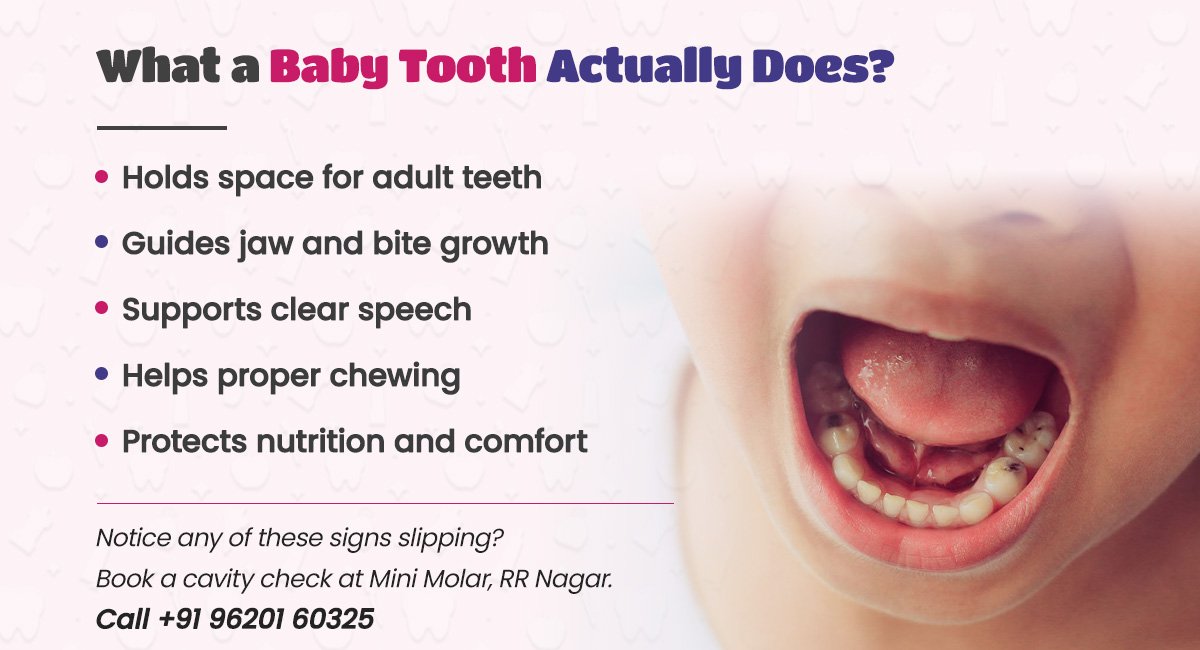
    Baby teeth keep space for the permanent teeth, guide jaw growth, help speech, and let a child chew properly.

    A lost tooth leaves a gap, and neighbouring teeth drift into it. The adult tooth can then arrive crooked. Front baby teeth help a toddler form sounds.Therefore, Early loss of such teeth may affect speech causing lisping, further initiate adverse habits like tongue thrusting and aesthetic concerns that may has indirect effect of bullying in school. Back baby molars stay until age 10 to 12, so a cavity in a 4-year-old’s molar can affect the tooth for six to eight years. Left alone, a cavity can spread to the gum or damage the permanent tooth underneath.

    A pediatric dentist in RR Nagar can fit a space maintainer, a small appliance that holds the gap open until the adult tooth arrives.

    • What If Baby Teeth Fall Out Too Early or Too Late?

    A baby tooth lost well before its time, or one that hangs on long past its age, deserves a dental check.

    Early loss usually comes from decay or a knock to the mouth. Neighbouring teeth drift into the space, and the dentist may suggest an appliance to hold the space.

    Late shedding is harder to spot. Ask for a check if your child hasn’t lost any baby tooth by around age 8. Ask too if an adult tooth is still missing long after its baby tooth fell out, or if the permanent teeth look crowded. An early orthodontic evaluation around age 7 gives the dentist a chance to review eruption, spacing and bite.

    • How Should You Care for Teeth During the Shedding Years?

    Brush twice a day for two minutes with fluoride toothpaste, floss where teeth touch, and see the dentist every six months. During mixed dentition, when baby and permanent teeth sit side by side, plaque collects in extra spots.

    Between ages 7 and 12, children brush on their own but still miss spots. Check their teeth afterwards.

    • Replace the toothbrush every 3 months, or sooner after an illness
    • Skip food and drink except water after the bedtime brush
    • Keep sweets and juice to mealtimes, and offer water between meals
    • Add a mouthguard for contact or stick sports
    • Check new molars for deep grooves, stained pits and trapped food

    Sealants protect those new molars. A sealant is a thin coating on the chewing surface that blocks decay. Dentists place sealants on first permanent molars at 6 to 7 years and on second molars at 11 to 13 years. Children at higher risk of cavities come every 3 to 4 months.

    smart snacks for growing teeth

    • When Should You Call the Dentist During the Shedding Years?

    Some signs need a same-day call to the clinic. They point to infection or injury, and waiting makes treatment harder.

    • Facial swelling
    • Severe toothache
    • A broken front tooth
    • A tooth that has turned grey after a fall
    • Pain that wakes your child at night

    Other signs can wait for a routine visit. Book an appointment for white lines near the gum, brown spots, gums that bleed when brushing, or food packing between teeth. Book one too if bad breath won’t clear, or if a shark tooth sits beside a baby tooth that stays firm.

    Never reinsert a baby tooth. A knocked-out permanent tooth needs fast action.

    • Hold the tooth by the crown
    • Rinse the tooth gently
    • Store the tooth in milk or saline
    • Reach the clinic as quickly as possible

    Go to a hospital emergency room for a head injury, nose bleeding,jaw fracture, deep cut, trouble breathing, or bleeding that won’t stop.

    Book a Check-Up at Mini Molar Kids Dental Clinic

    Most children don’t have any trouble losing their baby teeth. A check-up every six months still helps. The dentist confirms the adult teeth are arriving on schedule and catches decay in the molars that have to last a lifetime.

    Mini Molar Kids Dental Clinic treats children only. Orthodontists and a prosthodontist on the team review how teeth erupt and meet as your child grows. Parents can stay in the room. The dentist takes X-rays only when there’s a clinical reason. For swelling, severe toothache, a broken front tooth or night pain, the clinic keeps same-day slots.

    Parents searching for the best pediatric dentist in RR Nagar, or a pediatric dentist in Rajarajeshwari Nagar, can book on +91 96201 60325. The clinic is located at No 1132, 1st Floor, Jawaharlal Nehru Road, BEML Layout 3rd Stage. Bring your questions and a note of which teeth have come out and when.

    This content is for parent education only. A dentist must examine your child’s teeth, gums, and any X-ray findings before confirming a diagnosis or treatment plan.

    Frequently Asked Questions

    At what age does a child lose the first baby tooth?
    Most children lose the first baby tooth around age 6, usually a lower front tooth. A child who got teeth late often loses them late, so a first loss at 5 or 7 usually doesn’t signal a problem.

    What if my child loses a baby tooth before age 5?
    Mention the early loss at the next dental visit. A baby tooth lost before age 5 often traces back to decay or an injury. A pediatric dentist in RR Nagar checks whether a space maintainer should hold the gap open for the adult tooth.

    What if my child swallows a baby tooth?
    Don’t panic. A swallowed baby tooth passes through the body without harm in most cases. Call the clinic if your child has stomach pain or trouble swallowing.

    How many baby teeth does a child lose?
    A child loses all 20 baby teeth. Eight extra permanent molars arrive behind them with no baby tooth to replace. Most children have 28 permanent teeth by about age 13, and wisdom teeth bring the total to 32.

    Does losing a baby tooth hurt?
    A loose tooth can feel odd or slightly tender. Sharp pain, swelling or fever isn’t normal. Call the clinic if your child has any of them.

    Does my child need a dental visit every time a tooth falls out?
    There’s no need for a special visit after a normal loss. Keep the routine check-up every six months. Call sooner for pain or swelling. Also call if an adult tooth appears behind a baby tooth that stays firm for a few weeks.

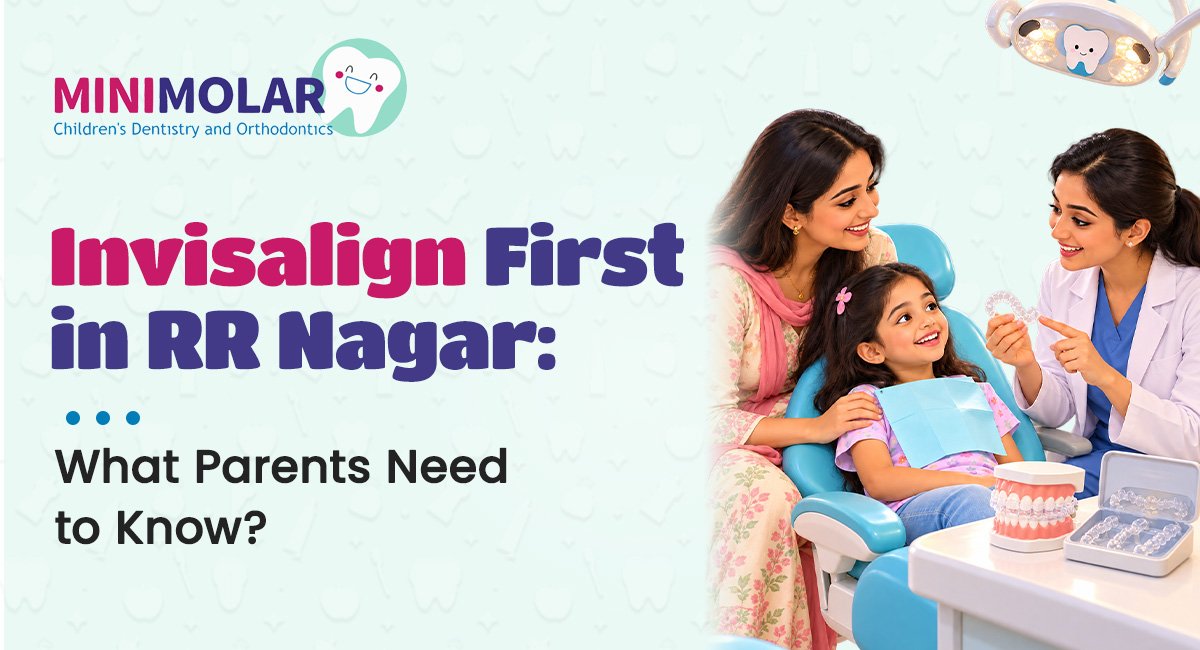
  • Invisalign First in RR Nagar: What Parents Need to Know?

    Invisalign First in RR Nagar: What Parents Need to Know?

    A dentist has likely mentioned crowding, a gap, or a bite issue in your child’s mouth. Now a real decision sits in front of you: start early orthodontic treatment now, or wait. Invisalign First in RR Nagar is designed for children aged 6 to 10 who still have a mix of baby and adult teeth. This is your ultimate guide to Invisalign First for parents, covering how Mini Molar Children’s Dentistry decides whether a specific child is a candidate, what the treatment process involves, and what tends to happen when families choose to wait.

    The orthodontic team at Mini Molar Children’s Dentistry evaluates every child individually before recommending Invisalign First. The team checks jaw growth, tooth development, and bite alignment, without applying a blanket age-based rule. If a child isn’t ready for the daily responsibility that an aligner wear demands, the team says so directly. An individualised evaluation, not a standard age cutoff, determines whether early treatment actually helps a specific child, rather than simply adding cost and time with no clear benefit.

    Is My Child a Candidate for Invisalign First?

    A child becomes a candidate for Invisalign First when specific signs of crowding, spacing, or bite misalignment appear while adult teeth are still coming in. The team at Mini Molar Children’s Dentistry checks for these signs during a hands-on evaluation, not a quick visual glance. The evaluation ideally happens around age 7, per the general guideline most clinics follow.

    The signs that typically prompt an evaluation include:

    • Crowded or overlapping teeth
    • Visible gaps between teeth
    • An underbite, overbite, or crossbite
    • A narrow dental arch
    • Rotated teeth
    • Front teeth that protrude or tuck inward noticeably

    Age 6 to 10 matters specifically because the child still has mixed dentition, a mouth with both baby and adult teeth present at once. The orthodontic team can guide how the remaining adult teeth come in during mixed dentition, a kind of guidance that becomes far harder to achieve once every adult tooth has erupted. Early evaluation during this window is the reason age 6 to 10 is the stated range, not an arbitrary cutoff.

    What Happens If We Wait Instead of Starting Now?

    Waiting is sometimes the right call, and sometimes the wrong one, depending on what the dentist actually finds. Not every child flagged at a routine check needs immediate treatment, and the team at Mini Molar Children’s Dentistry won’t recommend starting treatment just to open a case.

    Early treatment at this stage can prevent several outcomes from developing further:

    • Severe crowding that later requires extractions
    • Adult teeth that become impacted and can’t erupt properly
    • A bite that worsens over time, along with uneven tooth wear
    • Uneven jaw growth
    • Chipped front teeth from incisors that stick out
    • Ongoing strain on the gums
    • Speech difficulties tied to tooth position
    • A longer, more complex Phase 2 treatment later on

    A child with only mild spacing, expected to self-correct as more adult teeth erupt, may not need Phase 1 treatment at all. The evaluation stays individual for exactly this reason: a blanket recommendation would treat every child in the age range the same way, regardless of actual need.

    invisalign in RR nagar are you the right candidate or must wait

    How Does Mini Molar Children’s Dentistry Choose Between Invisalign First, an Expander, or Early Braces?

    The orthodontic team chooses the appliance based on what the specific case requires, with no default preference for one option over another. Invisalign First handles a wide range of early bite and spacing issues well, though the treatment does have one stated limit, and the team stays upfront about the limit.

    Invisalign First treats crowding, narrow arches, most bite misalignments, and rotated or protruding teeth effectively. A palatal expander may still be the better tool where the jaw bone itself needs significant widening, beyond what the teeth and surrounding bone can support through aligners alone. The dentist grades the severity of each case and recommends the appliance that actually matches the case, not the option that’s simplest to prescribe.

    What Does the Invisalign First Process Actually Look Like?

    The treatment process runs through six stages, from the first scan to the final retention phase, with parents seeing a projected outcome before committing to treatment.

    1. Consultation and 3D scan. A digital scan replaces traditional impressions and captures the current state of the teeth and bite.
    2. Simulation. The ClinCheck simulation shows parents a projected result before any aligner is made.
    3. Custom aligners. The child receives a series of aligners, with coaching on wearing the aligners consistently.
    4. Monitoring and fit checks. Regular visits confirm the aligners are fitting and working as planned.
    5. Refinement and retainers. The team makes adjustments as needed, followed by retainers once active tooth movement is complete.
    6. Phase 2 reassessment. Once all adult teeth have erupted, the team reassesses whether further treatment is needed.

    What Does Daily Life Look Like for a Child Wearing Invisalign First?

    A child in Invisalign First wears the aligners 20 to 22 hours a day, removing the aligners only to eat and drink anything besides water. Consistent wear time, more than any single feature of the appliance, determines treatment outcome.

    Daily life includes a few specific habits:

    • Changing to a new tray every 1 to 2 weeks
    • Mild pressure for 1 to 2 days after each tray change
    • Speech adjusting within a few days of starting treatment
    • Drinking only water while wearing the aligners
    • Carrying a school kit with a case, travel brush, toothpaste, and floss
    • Avoiding hot water when cleaning the aligners
    • Keeping both the current and next tray on hand while travelling

    The team at Mini Molar Children’s Dentistry tells families directly when a child isn’t ready for this level of responsibility. Starting treatment too soon, without that readiness, wastes time and money without the expected benefit.

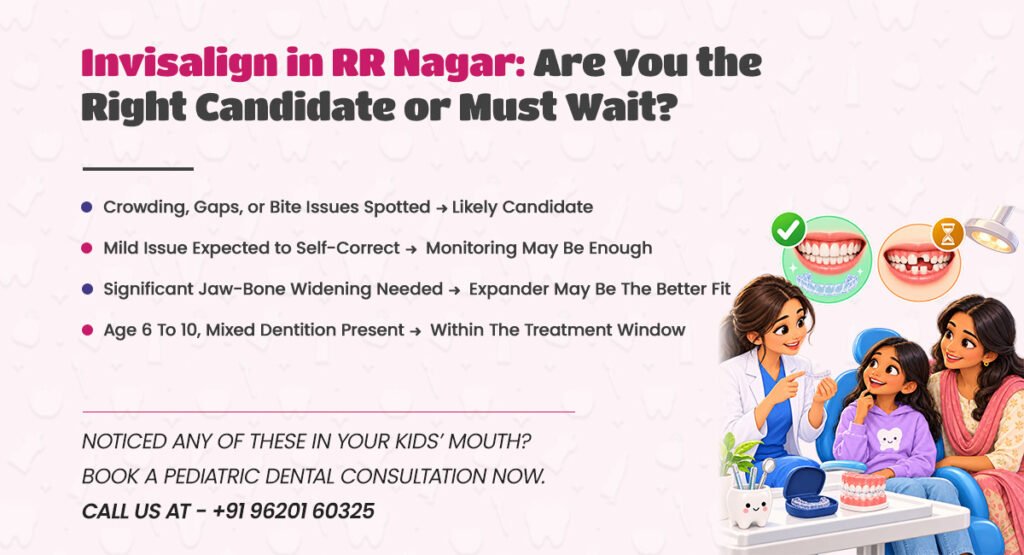
    • Crowding, Gaps, or Bite Issues Spotted → Likely Candidate
    • Mild Issue Expected to Self-Correct → Monitoring May Be Enough
    • Significant Jaw-Bone Widening Needed → Expander May Be the Better Fit
    • Age 6 to 10, Mixed Dentition Present → Within the Treatment Window

    Ask Mini Molar Children’s Dentistry Which Category Your Child Falls Into
    Call Us at +91 96201 60325

    What Does Invisalign First Cost, and What Should Parents Ask at Consultation?

    Invisalign First cost depends on the complexity of the case, the number of aligners needed, and whether insurance applies. Mini Molar Children’s Dentistry discusses the expected cost range directly at consultation, rather than publishing a fixed figure online. Insurance coverage and flexible payment plans get explained at that same consultation.

    Parents are better placed to plan ahead by asking a few direct questions at the first visit: the expected number of aligners, the likely treatment duration for their child’s specific case, whether insurance applies, and what payment plans are available.

    Book an Invisalign First Evaluation at Mini Molar Children’s Dentistry

    Mini Molar Children’s Dentistry in Rajarajeshwari Nagar evaluates each child individually for Invisalign First. The orthodontic team works specifically with children’s dental care and checks jaw growth, tooth development, and bite alignment before recommending any treatment path. Parents see the projected treatment outcome before treatment begins, and the team states clearly when a child needs more time before taking on the responsibility of daily aligner wear, a straightforward answer families consistently say they value.

    Parents searching for an invisalign for kids in RR Nagar or a best dentist for kids near me can call +91 96201 60325 to book a consultation and 3D scan. Bring any specific concerns a dentist has already raised, since dental history shapes the evaluation from the first visit.

    This content is for parent education only. An orthodontic evaluation is needed before confirming whether a child is a candidate for Invisalign First or any other treatment.

    Frequently Asked Questions

    Will my child definitely need braces later even with Invisalign First?
    Not always. Phase 1 treatment with Invisalign First can reduce or simplify the need for further treatment later. A Phase 2 reassessment, which happens once all adult teeth have erupted, confirms what further treatment, if any, is still needed.

    What if my child isn’t responsible enough to wear it 20 or more hours a day?
    The orthodontic team will say so directly during the evaluation. Consistent wear time matters more to treatment outcome than almost any other factor, so starting before a child can manage that responsibility isn’t recommended.

    Is Invisalign First worse than waiting for regular braces?
    Not for most early cases. Early treatment can prevent several issues, including severe crowding, impacted adult teeth, and a longer Phase 2 later. Some mild cases are better served by simply monitoring growth.

    Does Invisalign First work for severe crowding?
    Treatment outcome depends on the case. Invisalign First treats a wide range of crowding and spacing issues effectively, though cases needing significant widening of the jaw bone itself may require a palatal expander instead.

    What if a tray gets lost or broken?
    Call the clinic right away, rather than skipping ahead to the next tray or falling behind on the sequence. The orthodontic team adjusts the treatment schedule based on what has actually happened, not a guess made at home.

  • Painless Dental Treatment for Kids in RR Nagar: How We Keep Kids Comfortable?

    Painless Dental Treatment for Kids in RR Nagar: How We Keep Kids Comfortable?

    You’re not booking this pediatric dental appointment lightly. Maybe your child had a bad experience before, maybe they’re just scared of anything that sounds like “dentist,” and you’re wondering if this visit is going to be a fight.

    Painless dental treatment for kids in RR Nagar, at Mini Molar Kids Dental, means a specific set of steps we follow before, during, and after every procedure:

    • Numbing gel before an injection, when numbing is needed,
    • Child-friendly explanations before we touch a single tool,
    • The option to pause or reschedule if a child truly can’t cope that day.

    We’re a pediatric-only dental clinic in Rajarajeshwari Nagar, and the same dentist sees your child at every visit, so nothing here is a one-time script. Read on and you’ll know exactly what happens in the chair at our kids dental clinic in RR Nagar, step by step.

    What Does “Painless Dental Treatment” Actually Mean for Kids?

    It means our pediatric dentists work to keep pain and fear as low as possible at every stage, not that every child feels absolutely nothing. No honest dentist can promise zero sensation for every procedure and every child.

    What we can promise is a process built to reduce pain sharply and manage any discomfort that remains.. That includes topical numbing before injections, slow and careful technique, and stopping the moment a child is in real distress instead of pushing through.

    What Comfort Techniques Do We Use Before Any Dental Treatment Starts?

    We use behaviour guidance, which just means specific ways of talking to and preparing a child so they know what’s coming and feel some control over it. This starts before we touch anything.

    The core technique is called Tell-Show-Do. We tell your child what we’re about to do in simple words, show them the tool or step on a finger or a model first, then do it. No surprises, no sudden movements.

    Alongside that, we use:

    • Distraction. Stories, games, or music during the actual procedure, so attention isn’t fixed on what’s happening in the mouth.
    • Short appointments with breaks. We don’t push through a long procedure in one stretch if a child needs a pause.
    • Parent in the room. You stay close, especially for younger children.
    • Lap exams for babies and toddlers. Your child sits facing you, close to you, for the exam.

    Every one of these exists for one reason: a calm child cooperates better, and a child who cooperates gets treated faster and with less discomfort.

    How Do We Manage Numbing and Anaesthesia for Kids?

    We apply a numbing gel to the gum before an injection, so your child feels pressure rather than the needle itself. This one step removes most of the fear kids associate with “the dentist.”

    Local anaesthesia is used when indicated, meaning only when the specific procedure needs it, and only after we’ve checked your child’s medical history ,relevant allergies, and taken your consent. We don’t inject as a default step. Many cleanings, sealants, and fluoride treatments need no anaesthesia at all.

    If your child does need an injection, expect this order: topical gel first, time for it to take effect, then a slow, careful injection. Numbness typically sets in within a few minutes.The timing and degree of numbness can vary depending on the anaesthetic and the procedure.

    What If My Child Is Highly Anxious or Has Sensory Sensitivities?

    We slow down further, and we stop if we need to. This isn’t a fallback plan, it’s built into how we treat every anxious child from the first minute.

    Our pediatric dentists are trained in special needs dentistry, which covers children with sensory sensitivities, autism, or any condition that makes a standard visit harder to manage. As our team puts it, a lot of kids just need someone to slow down and explain what’s happening before touching anything.

    If a child is too distressed to continue safely, we simplify the remaining steps or reschedule the visit entirely. We won’t restrain a child through a procedure just to finish it in one sitting. A second, calmer visit may produce a better result than pushing through the first one.

    What Actually Happens During a Kid’s Dental Visit?

    A visit follows five steps, in this order, every time:

    1. History and Exam. We ask about your child’s health and look at their teeth. Photos or X-rays are taken only if there’s a clinical reason for them.
    2. Diagnosis & a Written Plan. This covers cavity risk, how teeth are erupting, and whether an orthodontic screening makes sense.
    3. Professional Cleaning.
    4. Treatment, matched to what’s actually needed: a tooth-coloured filling, a pulpotomy (removing infected tissue from inside a baby tooth’s crown while keeping the healthy root), a pulpectomy (the same idea, done deeper into the root), a crown, or, if a tooth can’t be saved, an extraction with a space maintainer to hold room for the permanent tooth.
    5. Home Guidance and a Follow-Up Schedule, based on your child’s specific risk level.

    Before any of steps 3 to 5 begin, we explain the diagnosis, the options, and the comfort measures to you directly. You know what’s happening and why before we start.

    Where possible, we go conservative first.

    • An early white spot on a tooth often just needs fluoride gel or varnish to remineralise it, which means rebuilding the mineral content the tooth already lost, no drilling required.
    • We also use SDF (silver diamine fluoride) with your consent for some early cavities. It stops decay without a drill, though the treated spot does turn dark afterward. That colour change means it’s working, not that something’s wrong.

    What Should You Expect After Treatment?

    Expect some numbness for one to three hours, and mild tenderness, both of which are normal and not a sign anything went wrong. Watch your child during this window so they don’t accidentally bite their lip, cheek, or tongue while it’s still numb.

    Give soft, cool food until feeling fully returns. Pain relief, if needed, should only be given at the dose suited to your child’s age and weight, so check with us or a pharmacist rather than guessing. From the next day, a warm salt water rinse (half a teaspoon of salt in a cup of water) helps healing along.

    Call us if any of these happen:

    • Pain gets worse after 48 hours instead of easing
    • Swelling appears
    • Your child develops a fever
    • There’s a bad taste that doesn’t go away
    • Sensitivity lasts beyond a week

    How Can You Prepare Your Child at Home Before the Visit?

    Use plain, positive words and skip anything scary. Say “the dentist will count your teeth,” not “the dentist will check for cavities” or, worse, “it won’t hurt.” Kids pick up on the words you’re avoiding just as much as the ones you use.

    A few things that genuinely help:

    • Book a morning slot, when your child is less tired and more cooperative
    • Read a story about visiting the dentist beforehand
    • Bring a favourite soft toy
    • Practise “open wide” as a game at home
    • Keep pre-visit snacks light, and brush before you leave

    At the visit itself, stay calm yourself, and tell us your main concern first. Kids read a parent’s tension faster than anything we say.

    Book a Comfortable & Painless Dental Visit for Your Child in RR Nagar

    Painless dental treatment for kids in RR Nagar isn’t a slogan at Mini Molar Kids Dental, it’s Tell-Show-Do, numbing gel before injections, a written plan you see before treatment starts, and the willingness to pause or reschedule rather than force a procedure through. We’re a pediatric-only practice with MDS-qualified specialists, and your child sees the same dentist at every visit, so trust builds instead of resetting each time.

    If you’ve been searching for a kids dentist near me or a kids dental clinic in RR Nagar, call us at +91 96201 60325 to book a consultation. We also keep same-day emergency slots open for swelling, severe toothache, a broken front tooth, or pain that wakes a child at night. Come in, tell us what worries you most, and we’ll walk you through exactly what to expect before anything begins.

    This content is for parent education only. A dentist needs to examine your child directly before confirming any diagnosis or treatment plan.

    Frequently Asked Questions

    Is dental treatment for kids really painless?
    It’s designed to keep pain and fear as low as possible, using numbing gel, careful technique, and behaviour guidance, but no honest dentist can promise zero sensation for every child and every procedure.

    What is Tell-Show-Do in pediatric dentistry?
    It’s a technique where the dentist tells the child what’s about to happen, shows the step or tool first, usually on a finger, then does it. It removes the surprise that causes most dental fear in kids.

    Does Mini Molar treat children with dental anxiety or special needs?
    Yes. The team is trained in special needs dentistry and uses slower explanations, extra pauses, and rescheduling when a child is too distressed to continue safely.

    What happens if my child cries or refuses treatment?
    We slow down, simplify the remaining steps, or reschedule the visit entirely rather than force it through. A calmer second visit gets a better result than pushing through a difficult first one.

    Is local anaesthesia safe for young children?
    Yes, when it’s given after checking medical history and allergies and taking consent, which is our standard process. It’s used only when a specific procedure needs it, not as a default step.

    How long does numbness last after treatment?
    Usually one to three hours in the lips, cheeks, and tongue. Watch your child during this time so they don’t bite the numb area by accident.

    What if my child needs emergency dental care?
    Call us right away for swelling, a broken front tooth, severe toothache, or pain that wakes a child at night. Same-day emergency slots are kept open for exactly these situations.

  • Common Dental Issues in Children and How to Prevent Them!

    Common Dental Issues in Children and How to Prevent Them!

    Did you notice a dark spot on a back tooth, maybe your child pulling away from a cold glass of water, maybe just bad breath that wasn’t there last month. Your first thought is probably “is this normal, or should I worry?”

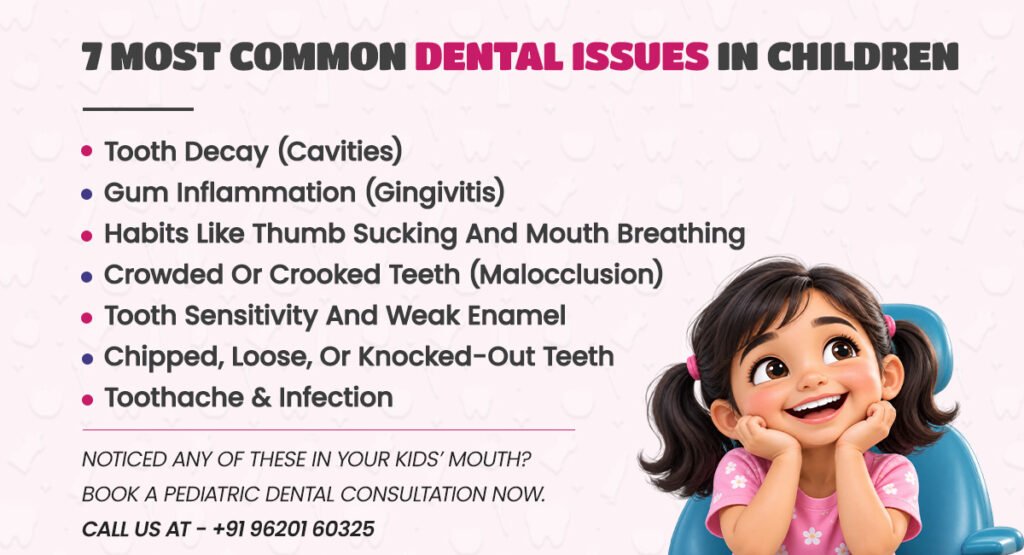
    The most common oral health issues in children are tooth decay, gum inflammation, thumb sucking or mouth breathing, crowded teeth, tooth sensitivity, dental injuries, and toothache from infection. Most of these are preventable with daily brushing, the right amount of fluoride toothpaste, a low-sugar diet, and a regular dental check-up.

    We hear this question every week at Mini Molar Kids Dental. We treat kids from their first tooth right through their last permanent molar, at our kids dental clinic in Rajarajeshwari Nagar. Therefore, what follows comes from what we actually see week to week, not a generic list copied from somewhere.

    Keep reading and you’ll know what each issue looks like, what you can do at home, and when it’s time to call us instead of waiting.

    7 most common dental issues in children

    How Does Tooth Decay Start in Kids, and How Do You Stop It?

    A cavity happens when bacteria in the mouth turn sugar into acid, and that acid slowly wears a hole into the tooth. It’s the most common oral health issues in children, and it’s also the one you have the most control over.

    Here’s what parents usually notice first:

    • White or chalky spots near the gumline
    • Brown or black stains
    • The tooth reacting to cold drinks or sweets
    • Your child chewing only on one side

    Prevention doesn’t need to be fancy, just consistent.

    • Under age 3, use a rice-grain smear of fluoride toothpaste.
    • From 3 to 6, move up to pea-sized.
    • Brush for two minutes, twice a day, and skip sweets after the bedtime brush.

    That last one matters more than most parents realise.

    If a cavity does form, don’t panic.

    • A small one usually just needs a simple filling.
    • A deeper one might need what we call a pulpotomy, which just means removing the infected part from inside the tooth’s crown while keeping the healthy root in place.

    It’s routine for us, it doesn’t hurt the way parents fear, and we do it specifically to save the tooth rather than pull it out.

    Why Do Kids Get Bleeding or Swollen Gums?

    That’s gum inflammation, or gingivitis, and it happens when plaque sits along the gumline too long and irritates the tissue underneath. You’ll usually notice the gums look a bit pink or puffy and bleed slightly when your child brushes.

    It’s not an emergency, but don’t ignore either, since it can get worse if you leave it.

    What actually works:

    • Brush right along the gumline, not just the tooth surface
    • Floss once a day once two teeth are touching
    • Change the toothbrush every three months, sooner after a cold or flu

    If the bleeding hasn’t settled after a week of better brushing, mention it at your child’s next visit and we’ll take a closer look.

    Should You Worry About Thumb Sucking or Mouth Breathing?

    Not right away. Most kids drop thumb sucking on their own by around age 4, and pacifiers are usually gone by 2 or 3.

    It becomes worth watching if the habit sticks around past that age, since it can start pushing the front teeth out of line, which then affects eating and speech.

    Mouth breathing is a different signal. If your child sleeps with their mouth open, snores, or seems to breathe through the mouth most of the day, tell us at the next visit. It’s often more about how the jaw and airway are developing than a habit issue on its own.

    Why Does My Child’s Tooth Feel Sensitive, or Why Does the Enamel Look Weak?

    Sensitivity means a tooth reacts sharply to cold, sweets, or sometimes just air. It usually comes down to the enamel, the hard protective coating on the tooth, wearing thin or forming unevenly in certain spots.

    You’ll usually spot this when your child suddenly stops eating ice cream, pulls back from a cold drink, or says one specific tooth “feels funny.” It’s less common than cavities, but it’s easy to overlook, since parents often assume it’s just a phase.

    A soft-bristled brush and a desensitising toothpaste help with mild cases. If the sensitivity is sharp, sudden, or stuck to one single tooth, come in and let us take a look rather than waiting it out, since it can sometimes point to deeper enamel damage than what you can see from outside.

    Why Do Some Kids End Up With Crowded or Crooked Teeth?

    Crowded and crooked teeth, which dentists call malocclusion, happen when there isn’t enough room for teeth to come in straight, or when the upper and lower jaw don’t quite match up.

    We use age 7 as a rough checkpoint for a first orthodontic look, sometimes called the “rule of 7.” It’s not a hard cutoff. It’s just a good moment to catch things early, since guiding a growing jaw is a lot easier than correcting it later.

    One thing most parents don’t expect: losing a baby tooth too early, from decay or an injury, lets nearby teeth drift into that empty space. That drift is a quiet, common cause of crowding that only shows up years down the line. It also ties into when teeth are supposed to come in.

    Most kids lose their front baby teeth around age 6, get their first permanent molars around 6 to 7, and their second molars around 11 to 13. If your child’s teeth are noticeably behind these windows, bring it up at a routine visit rather than guessing on your own.

    What Do You Do if Your Child Chips a Tooth or Knocks One Out?

    Move fast, but stay calm, since your child will take their cue from you. Rinse the area gently and hold a cold compress against it. If a piece of the tooth is available, keep it in milk, saline, or even your child’s own saliva.

    Don’t scrub the tooth clean, and don’t try to put it back in yourself unless it’s a permanent tooth (never a baby tooth). Call us immediately if it’s a permanent tooth, since getting to a dentist fast gives the best shot at saving it.

    One more thing to watch for: a tooth that turns grey a few weeks after a fall or a knock. The fall may have affected the nerve inside, even if everything looks fine on the outside. Get it checked rather than waiting to see what happens.

    How Do You Know if It’s a Wait-and-Watch Issue, or a Same-Day Visit?

    This is really the question behind everything above, so here’s the direct answer. Most changes in your child’s mouth can wait for a routine visit. A smaller list needs a same-day call to us.

    Usually fine to wait for a routine visit:

    • One white spot with no pain
    • Mild bad breath
    • Slight gum bleeding that’s improving with better brushing
    • A loose baby tooth with no swelling

    Call us the same day:

    • Swelling near the gums or face
    • Pain that wakes your child up at night, which often means the decay has reached the nerve and turned into an infection, which we sometimes call an abscess
    • A tooth that’s turned grey after a fall
    • A knocked-out or badly chipped tooth
    • Bleeding that hasn’t stopped after 10 minutes of gentle pressure

    An abscess won’t clear up on its own, no matter how much you brush or rinse. We need to drain the infection and treat what’s causing it, whether that means a filling, a pulpotomy, or, if the infection has gone deeper, a pulpectomy, where we treat the nerve further down into the tooth’s root.

    Why Does Prevention Change So Much by Age?

    Because what a 2-year-old needs and what a 10-year-old needs aren’t the same thing, and treating them identically means you’ll miss something.

    • Ages 0 to 3: Bring your child in by their first birthday, or within six months of that first tooth showing up. Wipe their gums after feeds even before teeth appear, and stop bedtime bottles of anything other than water by 12 to 18 months.
    • Ages 3 to 6: You brush, your child “helps.” Start flossing once two teeth touch. Dark lines near the gums or breath that won’t go away is worth a cleaning visit.
    • Ages 7 to 12: Check their teeth after they brush, since their technique is still catching up. This is also a good age to ask us about an orthodontic check and, if they play sports, a proper mouthguard.

    According to the National Oral Health Survey, dental caries affects 51.9% of 5-year-olds, 53.8% of 12-year-olds, and 63.1% of 15-year-olds in India. That’s a big number, and it’s exactly why catching things early makes such a difference.

    Book a Check-Up With Us at Mini Molar Kids Dental

    Most common oral health issues in children follow the same pattern. Catch it early, handle what you can at home, and don’t wait once something points to more. You don’t have to figure it all out yourself, that’s what we’re here for.

    We see children from their first tooth onward at Mini Molar Kids Dental in Rajarajeshwari Nagar, and a routine check-up is the simplest way to stay ahead of everything on this list. If you’ve been searching for a child dentist near me or a kids dentist near me around RR Nagar, give us a call at +91 96201 60325 and we’ll get you booked in.

    Bring your questions along too. We’d rather answer them now than after something small has turned into something bigger.

    This content is for parent education only. A dentist needs to examine your child’s teeth, gums, and any X-ray findings before confirming a diagnosis or treatment plan.

    Frequently Asked Questions

    What is the most common dental problem in children?
    Tooth decay. It happens when bacteria turn sugar into acid that wears down the enamel, and regular brushing with the right amount of fluoride toothpaste gives your child the best defence against it.

    At what age should my child first see a dentist?
    By their first birthday, or within six months of their first tooth, whichever comes first. This early visit mostly helps your child get comfortable in the dental chair before anything needs fixing.

    Do cavities in baby teeth need treatment if the tooth is going to fall out anyway?
    Yes. If you leave a cavity untreated, it can cause pain, infection, and early tooth loss, and this affects chewing, speech, and the space a permanent tooth will need later. Baby teeth matter more than their short lifespan suggests.

    How do I know if my child’s tooth injury needs a same-day visit?
    Swelling, a grey tooth, bleeding that won’t stop, or a knocked-out permanent tooth all need same-day attention. A small chip with no pain can usually wait for a scheduled visit.

    Why does my child’s tooth hurt at night?
    Pain that wakes a child up at night usually means decay has reached the nerve inside the tooth. Don’t just manage this with pain relief, since it almost always means an infection is already there.

    Is thumb sucking bad for my child’s teeth?
    Not before age 4. Past that age, it can start pushing the front teeth out of line, so mention it at a check-up if it hasn’t stopped by then.

    How often should my child visit the dentist?
    Every six months for most kids, or every three to four months if they’re at higher risk for cavities. We’ll tell you which schedule fits your child.

  • Best Pediatric Dentist in RR Nagar for Cavity Prevention in Kids

    Best Pediatric Dentist in RR Nagar for Cavity Prevention in Kids

    Mini Molar Kids Dental is the pediatric dentist in Rajarajeshwari Nagar built specifically around cavity prevention in kids. Treatment does not wait until decay has already appeared. Mini Molar runs a risk-based prevention system: the team assesses each child’s actual cavity risk first, then matches the recall schedule, fluoride plan, and sealant decision to that specific risk level.

    Mini Molar treats children from their first tooth through their last permanent molar. The team tracks every child’s dental history as a single continuous record, a model known as a dental home, so each visit builds on the last one.

    The sections below, by our expert pediatric dentists at RR Nagar, explain exactly all about Pediatric Dentist in RR Nagar for Cavity Prevention in Kids and why early prevention always works!

    In Pediatric Dentistry, Why Does a Risk-Based Approach Matter More Than a Standard Cleaning?

    A standard cleaning treats every child the same way, regardless of how likely that specific child is to develop a cavity. Mini Molar’s risk-based approach identifies each child’s actual risk level first, then builds the treatment plan around that result.

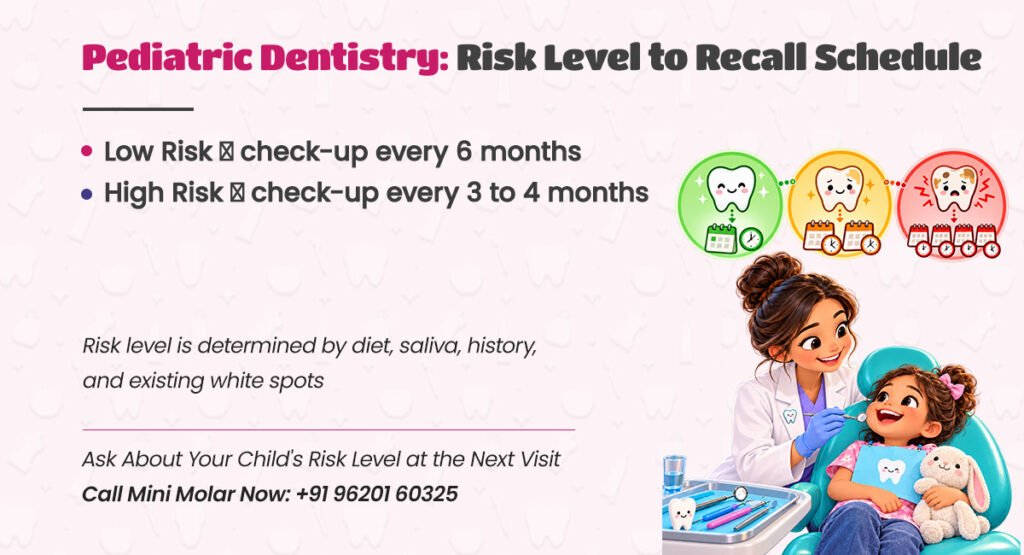
    Two children with similar-looking teeth can carry very different cavity risk. Diet, saliva quality, past dental history, and whether early white-spot lesions have already appeared all shape that risk. A six-month cleaning cycle suits a low-risk child well. A high-risk child on that same schedule can develop a cavity between visits, one a shorter recall interval would catch in time.

    What Experience and Focus Does Mini Molar Bring to Children’s Dentistry?

    Mini Molar focuses on one area: children’s teeth. The team includes pediatric dental specialists, orthodontists, and a prosthodontist, all within the same pediatric-only practice. A family gets cavity care, orthodontic care, and emergency care under one roof.

    Two things form the foundation of this approach:

    • A Dental Home Model. The pediatric dentists team tracks a child’s dental history as one ongoing record across years. This continuity lets the team spot risk changes as a child grows.
    • A Pediatric-Focused Team. Every dentist at Mini Molar works exclusively with children, from infants attending their first check-up to teenagers completing orthodontic treatment.

    What Does a Caries Risk Assessment Actually Involve?

    A caries risk assessment is a structured review of the specific factors known to increase a child’s chance of developing a cavity. The team carries this out before making any treatment decision. The result places a child into a risk category, and that category determines the recall interval and preventive treatment that follows.

    The assessment considers several factors together:

    • Diet, including how frequently a child consumes sugary or starchy snacks
    • Saliva quality, since saliva naturally helps protect teeth from acid
    • Existing white-spot lesions, which represent early and reversible decay
    • Dental history, including any previous fillings or cavities

    What Happens During a Cavity Prevention Visit at Mini Molar, Step by Step?

    A cavity prevention visit at Mini Molar follows a consistent sequence. Each step builds on the one before it, starting with history and ending with a clear plan for what comes next.

    1. History and diet review. The dentist discusses health background, current diet, and the child’s existing brushing routine first.
    2. Risk assessment and eruption tracking. The dentist assesses cavity risk factors and checks which teeth are erupting and how the bite is developing.
    3. Gum check and professional cleaning. The hygienist removes plaque and tartar through professional cleaning, known as prophylaxis, and reviews gum health.
    4. Fluoride and sealants where needed. The dentist applies these based on the child’s identified risk level.
    5. Home care coaching. The team gives specific guidance on brushing technique, diet adjustments, and habits such as thumb sucking.
    6. A written recall plan. Parents leave with a clear next appointment date based on the child’s actual risk level.

    The pediatric dentist in RR Nagar takes photographs and X-rays only when a genuine clinical reason exists.

    When Are Sealants and Fluoride Varnish Recommended, and at What Age?

    Mini Molar typically places sealants on first permanent molars around age 6 to 7, and on second permanent molars around age 11 to 13. These teeth carry deep grooves that trap bacteria and food debris most easily. A sealant works as a physical barrier, closing off those grooves before decay can start inside them.

    Fluoride varnish supports remineralisation, the process of rebuilding mineral content a tooth has already begun to lose. An early white-spot lesion represents exactly this kind of mineral loss. Catching that spot early is the central aim of this risk-based approach. A visible hole always needs a filling.

    pediatric dentistry  risk level to recall schedule

    How Does Mini Molar Keep Prevention Visits Comfortable for Anxious or Sensitive Children?

    Mini Molar uses behaviour guidance and, where appropriate, nitrous oxide sedation to keep every visit calm. A risk assessment and cleaning only produce accurate results when a child stays settled enough to cooperate through each step.

    Mini Molar’s comfort approach includes:

    • The dentist explaining each step in simple words before using any instrument
    • Distraction techniques during the visit itself
    • Nitrous oxide sedation for children who are especially anxious or sensory-sensitive
    • Parents present in the room throughout the visit
    • Strict infection control at every stage

    What Can Parents Do at Home Between Prevention Visits?

    Daily habits at home carry much of the responsibility for cavity prevention between appointments.

    • A rice-grain smear of fluoride toothpaste up to age 3, pea-size from age 3 to 6, and a normal amount from age 6 onward
    • No food or drink after the bedtime brush
    • Water between meals, with sweets limited to mealtimes
    • No sleeping with milk or a sweetened bottle
    • A toothbrush replaced every 3 months, or sooner after an illness

    These home habits directly shape which risk category a child falls into at the following visit.

    Book a Cavity Prevention Visit at Mini Molar Kids Dental

    Mini Molar Kids Dental in Rajarajeshwari Nagar runs cavity prevention as a structured, risk-based process. Each child gets a plan that matches their actual risk. A pediatric-only team or the best pediatric dentist in RR Nagar, a continuous dental history for every child, and comfort measures including behaviour guidance and nitrous oxide where appropriate all support this process.

    Anyone searching for a pediatric dentist in RR Nagar or kids cavity treatment in RR Nagar can call +91 96201 60325 to book a cavity-risk assessment, with same-day availability for anything urgent. Parents can raise all their queries and questions at the time of booking.

    This content is for parent education only. A dentist must examine a child directly before confirming any diagnosis, risk level, or treatment plan.

    Frequently Asked Questions

    How is a prevention visit at Mini Molar different from a regular cleaning?
    A caries risk assessment comes first, and this result decides the recall schedule and treatment plan for that specific child.

    How often will a child need to return for prevention visits?
    Every 6 months for a low-risk child, or every 3 to 4 months for a high-risk child. The child’s actual risk level sets this schedule.

    Do all children need sealants at Mini Molar, or only some?
    The team recommends sealants based on individual risk and tooth anatomy. Children with deeper grooves in their molars or higher cavity risk benefit the most from this treatment.

    Is nitrous oxide used during routine prevention visits at Mini Molar?
    Yes. For children who are especially anxious or sensory-sensitive, nitrous oxide sedation helps keep the visit calm enough for an accurate assessment and cleaning.

    At what age should cavity-risk assessments begin?
    As early as the first dental visit, ideally by a child’s first birthday or within six months of the first tooth appearing.

    Can early decay be reversed without a filling?
    Yes. A white-spot lesion, decay in its earliest and most reversible stage, can often remineralise with fluoride varnish and improved home habits. A visible hole always needs a filling.

  • Emergency Dentist for Child in RR Nagar: What Parents Need to Know?

    Emergency Dentist for Child in RR Nagar: What Parents Need to Know?

    If your child’s tooth is in pain, swelling or bleeding right now, call Mini Molar right away.

    An emergency dentist for a child in RR Nagar handles injuries, sudden pain, and anything that can’t wait for a scheduled visit. At Mini Molar, Dr. Pavan TP and team keeps same-day slots open for emergency situations, so a scared child and a panicking parent aren’t stuck waiting days for an appointment.

    What Does an Emergency Dentist for a Child in RR Nagar Actually Do?

    An emergency dentist is a different job from a routine check-up dentist, even though it’s often the same clinic and same team. A routine visit is planned, calm, and preventive. An emergency visit is none of those things. It’s:

    • Assessing an injury fast
    • Controlling pain or bleeding right away
    • Deciding on the spot whether a tooth can be saved or a follow-up procedure is needed.

    That means the child dental clinic, RR Nagar needs to actually have room for you the same day, not a slot three weeks out. It also means the team’s used to working with a child who’s frightened and in pain, not one calmly sitting through a scheduled cleaning. That difference actually shows up in small things:

    • How fast someone gets on the phone
    • Whether the dentist explains what’s happening in a way that keeps a scared child from panicking further
    • Whether pain gets addressed in the first few minutes instead of after a long wait.

    What Actually Counts as a Child Dental Emergency?

    Not everything that looks alarming needs an emergency visit to the child dentist near me, and not everything that seems minor can wait. A knocked-out or badly loosened tooth, uncontrolled bleeding, a tooth pushed out of position, or swelling that’s spreading are all emergencies. So is pain severe enough that a child can’t eat, sleep, or function normally.

    • A small chip with no pain isn’t usually an emergency.
    • Neither is a loose baby tooth that’s naturally ready to fall out, or mild sensitivity.

    These can wait for a regular appointment. If you’re unsure which category you’re in, call the Mini Molar and describe it, don’t just guess and hope it settles on its own.

    What Parents Should Do in a Child Dental Emergency?

    Thinking about what parents should do in a child dental emergency? Here is a situation wise guide. For a knocked-out tooth, the first thing to check is whether it’s a baby tooth or a permanent one, because the response is different.

    • If it’s a baby tooth, don’t try to put it back in. Keep the area clean, control any bleeding with gauze, and get to the dentist.
    • If it’s a permanent tooth, time matters a lot more. Pick it up by the crown, never the root. Rinse it gently with milk or saline if it’s dirty, never scrub it. If your child will cooperate, try placing it back in the socket. If not, store it in milk and get to the clinic within 30 minutes if at all possible.

    For a chipped or broken tooth, save any pieces you can find, they sometimes help with repair later.

    • Rinse the mouth with warm water
    • Apply a cold compress if there’s swelling.

    A small chip usually doesn’t need treatment within the hour, but a larger break exposing the inner tooth does, since that’s when infection risk goes up and pain worse.

    For a severe toothache without swelling:

    • Check first for anything stuck between the teeth
    • Give over the counter pain relief made for kids
    • Try gently flossing the area and visit a dentist.

    For severe toothache with Visible swelling-

    • Avoid hot/cold compress.
    • Pain medications wouldn’t help much in such cases.
    • Make an emergency dental appointment for immediate relief.

    For bleeding after natural tooth exfoliation, apply steady pressure with clean gauze for a full ten minutes without checking every thirty seconds. If it’s still going after that, get to the child dental clinic RR Nagar.

    what to do in the first few minutes

    What Happens When You Reach Mini Molar?

    Same-day emergency slots mean your child gets seen quickly, not squeezed in as an afterthought. Dr. Pavan TP and team does a fast but proper check, teeth, gums, jaw, and any soft tissue involved, before deciding on treatment.

    Pain control, saving a tooth if possible, bleeding control, or something urgent comes before anything else. The fuller treatment plan gets worked out once the child’s actually calm and out of immediate danger.

    Call Mini Molar Now for a Child Dental Emergency

    If your child’s in pain or you’re unsure whether this needs immediate care, don’t wait to decide. Mini Molar’s team, six dentists including specialist orthodontists alongside Dr. Pavan TP, follows strict infection control and uses behaviour guidance and pain-free techniques even in urgent situations, so your child isn’t just seen quickly, they’re handled calmly.

    Call +91 96201 60325 now, Mini Molar keeps same-day emergency slots open specifically for this.

    Frequently Asked Questions

    What counts as a dental emergency for a child?
    Knocked-out or loosened teeth, uncontrolled bleeding, severe pain, swelling that’s spreading, that’s the real list. A small chip or a bit of sensitivity almost never needs a same-day dentist.

    My child’s baby tooth got knocked out, should I put it back in?
    No, don’t. Baby teeth just don’t go back in the socket. Clean the area, keep bleeding under control with gauze, then get to the dentist when you can.

    How fast do I need to act if a permanent tooth gets knocked out?
    Fast, within 30 minutes if you can manage it. Every extra minute lowers the odds of saving that tooth.

    What should I use to store a knocked-out tooth?
    Milk, or saline if you’ve got it handy. Tap water’s the one thing to avoid, it damages the root.

    Do I need to go to the ER or can the dentist handle it?
    Dentist, in almost every case. A head injury, bleeding, nausea/vomiting/ loss of consciousness that won’t stop with pressure are really the only reasons to head to a hospital instead.

    My child’s tooth is loose but hasn’t come out, what now?
    If the child’s tooth is loose after a fall/Hit schedule a dentist visit for checkup, aftercare instructions & followup. If the Child’s tooth is loose due to natural exfoliation, nothing to worry.

  • Do Cavities in Baby Teeth Really Matter If They’re Going to Fall Out Anyway?

    Do Cavities in Baby Teeth Really Matter If They’re Going to Fall Out Anyway?

    Yes, they matter, more than most parents assume. A cavity in a baby tooth doesn’t just disappear when the tooth eventually falls out. It can cause pain, infection, and problems for the permanent tooth waiting underneath, all while that baby tooth is still sitting in your child’s mouth for years.

    At Mini Molar, Dr. Pavan TP team sees this exact question from parents constantly, usually right after a cavity’s just been spotted. And to answer that here is why do cavities matter in baby teeth?, and what waiting can actually cost you.

    Why Do Cavities Matter In Baby Teeth?

    Baby teeth aren’t just placeholders sitting around doing nothing until they fall out. They hold space for the permanent tooth growing underneath, and if a baby tooth is lost early because of decay, the teeth next to it can drift into that gap. The permanent tooth that was supposed to come up straight now has nowhere to go, or comes in crooked.

    They’re also doing quieter jobs most parents don’t think about.

    • Baby teeth guide how the jaw develops and how the bite lines up, which affects how straight or crowded permanent teeth eventually come in.
    • They help kids form certain sounds clearly while learning to talk, missing or damaged front teeth in particular can affect speech at exactly the age a child is learning to talk properly.
    • And they let a child chew properly, which matters for actual nutrition.

    What Happens If A Baby Tooth Cavity Is Left Untreated?

    The baby tooth cavity doesn’t just sit there quietly. A cavity left alone tends to grow. Eventually it reaches the nerve, and that’s when the real pain starts, the kind that makes a child stop eating certain foods or wake up at night.

    A few signs are worth watching for before it gets that far.

    • A dark spot or visible hole on a tooth. Sensitivity to hot, cold, or sweet food.
    • A child avoiding chewing on one side of their mouth.

    Any of these is worth a dentist’s look, even if your child hasn’t complained of pain yet.

    Left long enough, it can turn into an infection. That infection doesn’t always stay contained to one tooth either, it can spread to the gums or, worse, affect the permanent tooth still developing right underneath.

    And losing the baby tooth early because of this shifts the whole timeline your child’s mouth is supposed to follow.

    Aren’t Baby Teeth Going To Fall Out Soon Anyway?

    Some of them, yes, fairly soon. But not the ones that matter most here.

    The back molars, the teeth that get cavities most often, usually aren’t lost until somewhere between age ten and twelve. So a cavity that shows up in a four year old’s molar isn’t a problem for a few months, it’s potentially a problem for six to eight years.

    Does Every Cavity In A Baby Tooth Need To Be Filled?

    Not always, honestly. A very small cavity caught early sometimes gets managed with better brushing and diet changes instead of a filling right away. And if a tooth is genuinely close to falling out on its own, with no pain and no sign of infection, a dentist might reasonably decide to just let it be.

    But those are the exceptions, not the rule. Most cavities, especially ones that are already causing sensitivity or visible damage, do need a kids cavity treatment in RR Nagar.

    A dentist usually checks this with a simple visual exam, sometimes an X-ray if the cavity’s between teeth where it’s harder to see.

    Good habits at home lower the odds of getting to this point at all.

    • Brushing twice a day with a fluoride toothpaste
    • Cutting back on sugary snacks between meals
    • Keeping up with six-month check-ups catch most problems while they’re still small and easy to manage.

    what a baby tooth actually does

    How Are Baby Teeth Cavities Treated At Mini Molar?

    Treatment for kids cavities in RR Nagar depends entirely on how far the cavity has progressed. A small one might just need a filling, quick, done in one visit. A deeper cavity that’s reached closer to the nerve sometimes needs a bit more, like a pulpotomy, before it’s sealed up.

    • Either way, the team keeps the child in the loop the whole time, showing the tools, explaining what each one does in simple words, before anything actually touches a tooth.
    • The filling itself is done under local anaesthesia, so the child feels pressure at most, not pain.

    For milk teeth cavity treatment in RR Nagar, the priority is always keeping the visit calm, since a child’s first experience with a filling shapes how they feel about every dental visit after it. A rushed, tense first filling can make a child dread the dentist for years. A calm one at Mini Molar usually does the opposite.

    One Small Visit to Mini Molar Now Beats a Bigger One Later.

    If your child’s shown any sign of a cavity, sensitivity, a visible spot, or complaints about a tooth, don’t wait to see if it resolves on its own. Call +91 96201 60325 to book a check-up at Mini Molar, Rajarajeshwari Nagar.

    Baby teeth falling out eventually doesn’t mean cavities in them don’t matter right now. A cavity ignored today can mean pain, infection, or a crooked permanent tooth years down the line, all because a small problem was left alone for too long. Getting it checked is the only way to know what it actually needs.

    Frequently Asked Questions

    Why do cavities matter in baby teeth if they fall out anyway?

    Because the tooth stays in place for years first. A cavity can cause pain and infection long before that tooth is due to fall out.

    What happens if I just leave my child’s cavity untreated?

    It usually gets worse, not better. Pain, infection, and damage to the permanent tooth underneath are all real risks.

    When do baby teeth actually fall out?

    Front teeth go first, around age six. Back molars, which get cavities most, often stay until age ten or twelve.

    Does every baby tooth cavity need a filling?

    No. Very small ones sometimes don’t. Most do, though, and a dentist is the only one who can tell which is which.