
Invisalign First in RR Nagar: What Parents Need to Know?
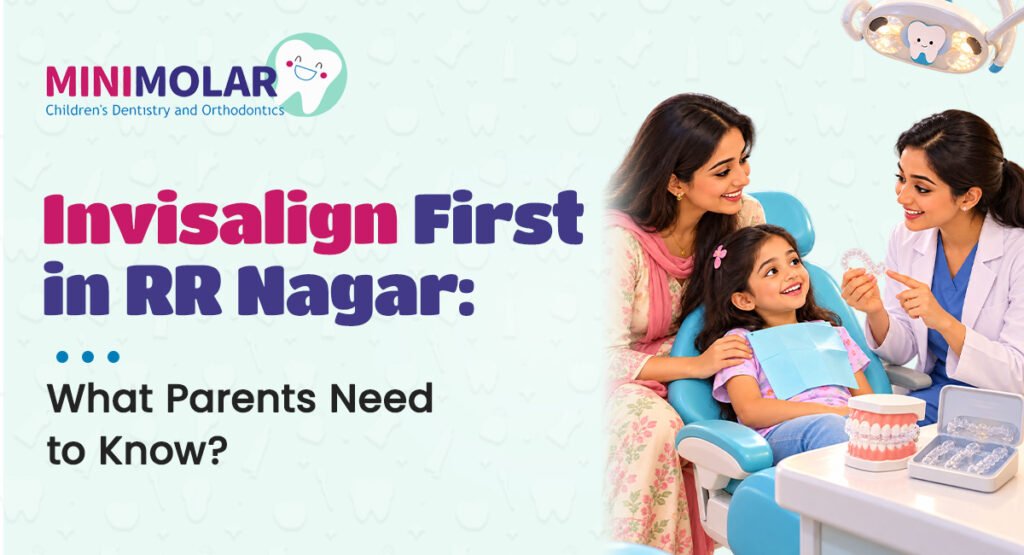
A dentist has likely mentioned crowding, a gap, or a bite issue in your child’s mouth. Now a real decision sits in front of you: start early orthodontic treatment now, or wait. Invisalign First in RR Nagar is designed for children aged 6 to 10 who still have a mix of baby and adult teeth. This is your ultimate guide to Invisalign First for parents, covering how Mini Molar Children’s Dentistry decides whether a specific child is a candidate, what the treatment process involves, and what tends to happen when families choose to wait.
The orthodontic team at Mini Molar Children’s Dentistry evaluates every child individually before recommending Invisalign First. The team checks jaw growth, tooth development, and bite alignment, without applying a blanket age-based rule. If a child isn’t ready for the daily responsibility that an aligner wear demands, the team says so directly. An individualised evaluation, not a standard age cutoff, determines whether early treatment actually helps a specific child, rather than simply adding cost and time with no clear benefit.
Is My Child a Candidate for Invisalign First?
A child becomes a candidate for Invisalign First when specific signs of crowding, spacing, or bite misalignment appear while adult teeth are still coming in. The team at Mini Molar Children’s Dentistry checks for these signs during a hands-on evaluation, not a quick visual glance. The evaluation ideally happens around age 7, per the general guideline most clinics follow.
The signs that typically prompt an evaluation include:
- Crowded or overlapping teeth
- Visible gaps between teeth
- An underbite, overbite, or crossbite
- A narrow dental arch
- Rotated teeth
- Front teeth that protrude or tuck inward noticeably
Age 6 to 10 matters specifically because the child still has mixed dentition, a mouth with both baby and adult teeth present at once. The orthodontic team can guide how the remaining adult teeth come in during mixed dentition, a kind of guidance that becomes far harder to achieve once every adult tooth has erupted. Early evaluation during this window is the reason age 6 to 10 is the stated range, not an arbitrary cutoff.
What Happens If We Wait Instead of Starting Now?
Waiting is sometimes the right call, and sometimes the wrong one, depending on what the dentist actually finds. Not every child flagged at a routine check needs immediate treatment, and the team at Mini Molar Children’s Dentistry won’t recommend starting treatment just to open a case.
Early treatment at this stage can prevent several outcomes from developing further:
- Severe crowding that later requires extractions
- Adult teeth that become impacted and can’t erupt properly
- A bite that worsens over time, along with uneven tooth wear
- Uneven jaw growth
- Chipped front teeth from incisors that stick out
- Ongoing strain on the gums
- Speech difficulties tied to tooth position
- A longer, more complex Phase 2 treatment later on
A child with only mild spacing, expected to self-correct as more adult teeth erupt, may not need Phase 1 treatment at all. The evaluation stays individual for exactly this reason: a blanket recommendation would treat every child in the age range the same way, regardless of actual need.
How Does Mini Molar Children’s Dentistry Choose Between Invisalign First, an Expander, or Early Braces?
The orthodontic team chooses the appliance based on what the specific case requires, with no default preference for one option over another. Invisalign First handles a wide range of early bite and spacing issues well, though the treatment does have one stated limit, and the team stays upfront about the limit.
Invisalign First treats crowding, narrow arches, most bite misalignments, and rotated or protruding teeth effectively. A palatal expander may still be the better tool where the jaw bone itself needs significant widening, beyond what the teeth and surrounding bone can support through aligners alone. The dentist grades the severity of each case and recommends the appliance that actually matches the case, not the option that’s simplest to prescribe.
What Does the Invisalign First Process Actually Look Like?
The treatment process runs through six stages, from the first scan to the final retention phase, with parents seeing a projected outcome before committing to treatment.
- Consultation and 3D scan. A digital scan replaces traditional impressions and captures the current state of the teeth and bite.
- Simulation. The ClinCheck simulation shows parents a projected result before any aligner is made.
- Custom aligners. The child receives a series of aligners, with coaching on wearing the aligners consistently.
- Monitoring and fit checks. Regular visits confirm the aligners are fitting and working as planned.
- Refinement and retainers. The team makes adjustments as needed, followed by retainers once active tooth movement is complete.
- Phase 2 reassessment. Once all adult teeth have erupted, the team reassesses whether further treatment is needed.
What Does Daily Life Look Like for a Child Wearing Invisalign First?
A child in Invisalign First wears the aligners 20 to 22 hours a day, removing the aligners only to eat and drink anything besides water. Consistent wear time, more than any single feature of the appliance, determines treatment outcome.
Daily life includes a few specific habits:
- Changing to a new tray every 1 to 2 weeks
- Mild pressure for 1 to 2 days after each tray change
- Speech adjusting within a few days of starting treatment
- Drinking only water while wearing the aligners
- Carrying a school kit with a case, travel brush, toothpaste, and floss
- Avoiding hot water when cleaning the aligners
- Keeping both the current and next tray on hand while travelling
The team at Mini Molar Children’s Dentistry tells families directly when a child isn’t ready for this level of responsibility. Starting treatment too soon, without that readiness, wastes time and money without the expected benefit.
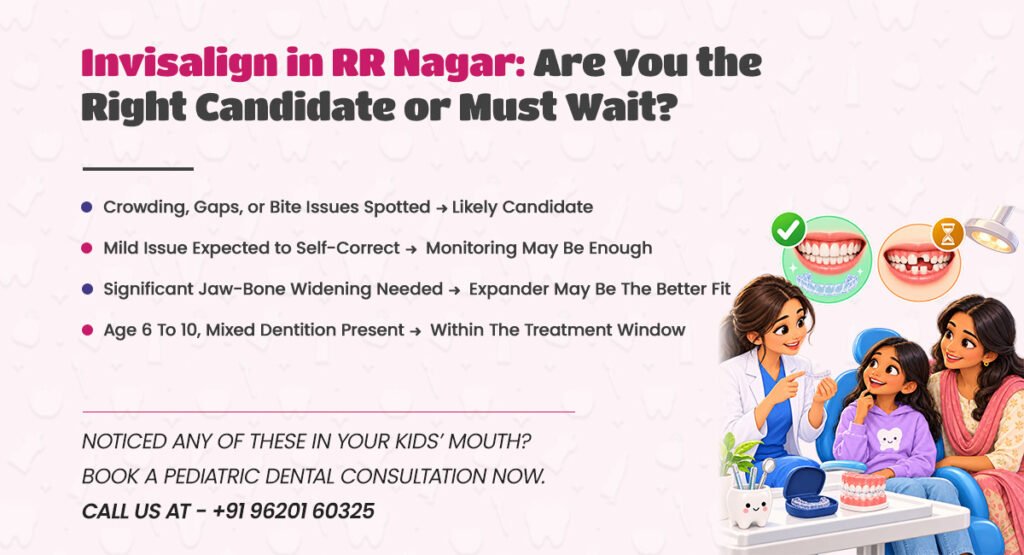
- Crowding, Gaps, or Bite Issues Spotted → Likely Candidate
- Mild Issue Expected to Self-Correct → Monitoring May Be Enough
- Significant Jaw-Bone Widening Needed → Expander May Be the Better Fit
- Age 6 to 10, Mixed Dentition Present → Within the Treatment Window
Ask Mini Molar Children’s Dentistry Which Category Your Child Falls Into
Call Us at +91 96201 60325
What Does Invisalign First Cost, and What Should Parents Ask at Consultation?
Invisalign First cost depends on the complexity of the case, the number of aligners needed, and whether insurance applies. Mini Molar Children’s Dentistry discusses the expected cost range directly at consultation, rather than publishing a fixed figure online. Insurance coverage and flexible payment plans get explained at that same consultation.
Parents are better placed to plan ahead by asking a few direct questions at the first visit: the expected number of aligners, the likely treatment duration for their child’s specific case, whether insurance applies, and what payment plans are available.
Book an Invisalign First Evaluation at Mini Molar Children’s Dentistry
Mini Molar Children’s Dentistry in Rajarajeshwari Nagar evaluates each child individually for Invisalign First. The orthodontic team works specifically with children’s dental care and checks jaw growth, tooth development, and bite alignment before recommending any treatment path. Parents see the projected treatment outcome before treatment begins, and the team states clearly when a child needs more time before taking on the responsibility of daily aligner wear, a straightforward answer families consistently say they value.
Parents searching for an invisalign for kids in RR Nagar or a best dentist for kids near me can call +91 96201 60325 to book a consultation and 3D scan. Bring any specific concerns a dentist has already raised, since dental history shapes the evaluation from the first visit.
This content is for parent education only. An orthodontic evaluation is needed before confirming whether a child is a candidate for Invisalign First or any other treatment.
Frequently Asked Questions
Will my child definitely need braces later even with Invisalign First?
Not always. Phase 1 treatment with Invisalign First can reduce or simplify the need for further treatment later. A Phase 2 reassessment, which happens once all adult teeth have erupted, confirms what further treatment, if any, is still needed.
What if my child isn’t responsible enough to wear it 20 or more hours a day?
The orthodontic team will say so directly during the evaluation. Consistent wear time matters more to treatment outcome than almost any other factor, so starting before a child can manage that responsibility isn’t recommended.
Is Invisalign First worse than waiting for regular braces?
Not for most early cases. Early treatment can prevent several issues, including severe crowding, impacted adult teeth, and a longer Phase 2 later. Some mild cases are better served by simply monitoring growth.
Does Invisalign First work for severe crowding?
Treatment outcome depends on the case. Invisalign First treats a wide range of crowding and spacing issues effectively, though cases needing significant widening of the jaw bone itself may require a palatal expander instead.
What if a tray gets lost or broken?
Call the clinic right away, rather than skipping ahead to the next tray or falling behind on the sequence. The orthodontic team adjusts the treatment schedule based on what has actually happened, not a guess made at home.




Recent Comments -
No Comments yet